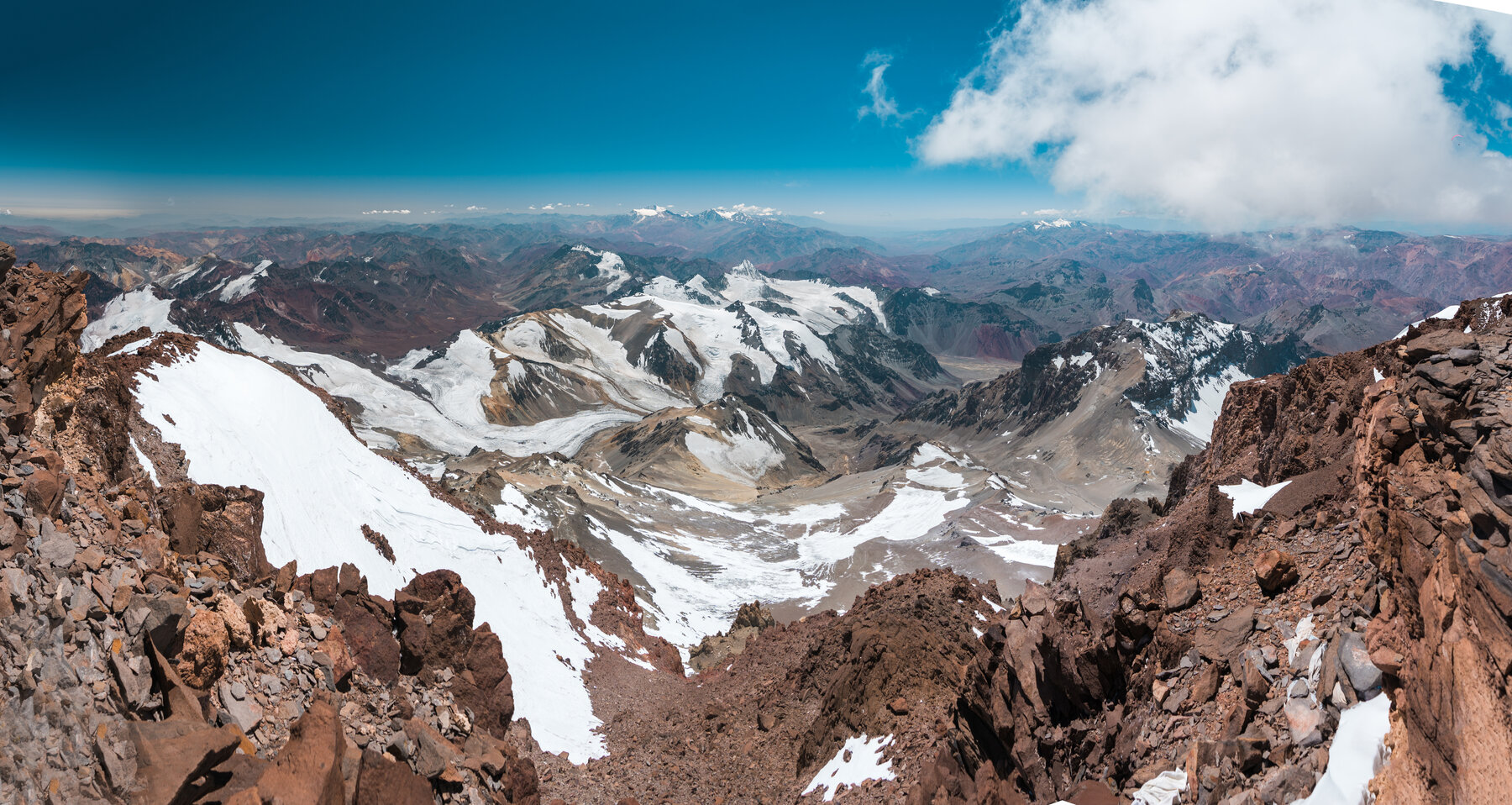
Seven Summits · No. 2 of 7

Aconcagua: The Roof of the Americas

Sixteen days in the Argentine Andes, four camps on loose scree and ice, and a summit push to 6,961 meters on the tallest peak outside of Asia.

Elevation
6,961 m / 22,838 ft
Location
Andes, Argentina
Summit Date
February 13, 2019
Route
Normal (Northwest)
Days on Mountain
16 (approach + 4 camps)
Guide Company

Seven months after standing on the summit of Kilimanjaro, we were back at it. This time the target was Aconcagua, the tallest mountain in the Western Hemisphere and the highest peak on Earth outside of Asia. At 6,961 meters it would be a significant step up from Kilimanjaro's 5,895, and our first real taste of extreme altitude. Grace and I knew this one would hurt.

Aconcagua sits in the Andes of western Argentina, just east of the Chilean border. It's a massive peak with a reputation for brutal wind and deceptive difficulty. It's not technical in the traditional sense, no ropes or ice climbing required on the normal route, but the altitude is punishing. Above 6,000 meters your body starts to break down, and the weather can turn violent without warning. More people fail on Aconcagua than succeed.

We flew into Mendoza, the wine capital of Argentina, and spent a day sorting gear and permits before driving three hours west to the Horcones Valley trailhead at the edge of Aconcagua Provincial Park. From there, we'd spend over two weeks working our way up through Confluencia Camp, Plaza de Mulas base camp, and three progressively higher camps before making our push for the top. Mountain Professionals, led by Ryan Waters, would be guiding us. What followed was sixteen days of scree, wind, cold, and one of the hardest things we've ever done.


Days 1–3: The Approach to Confluencia
February 1–3, 2019 · Horcones Valley → Confluencia Camp · 3,400 m / 11,150 ft

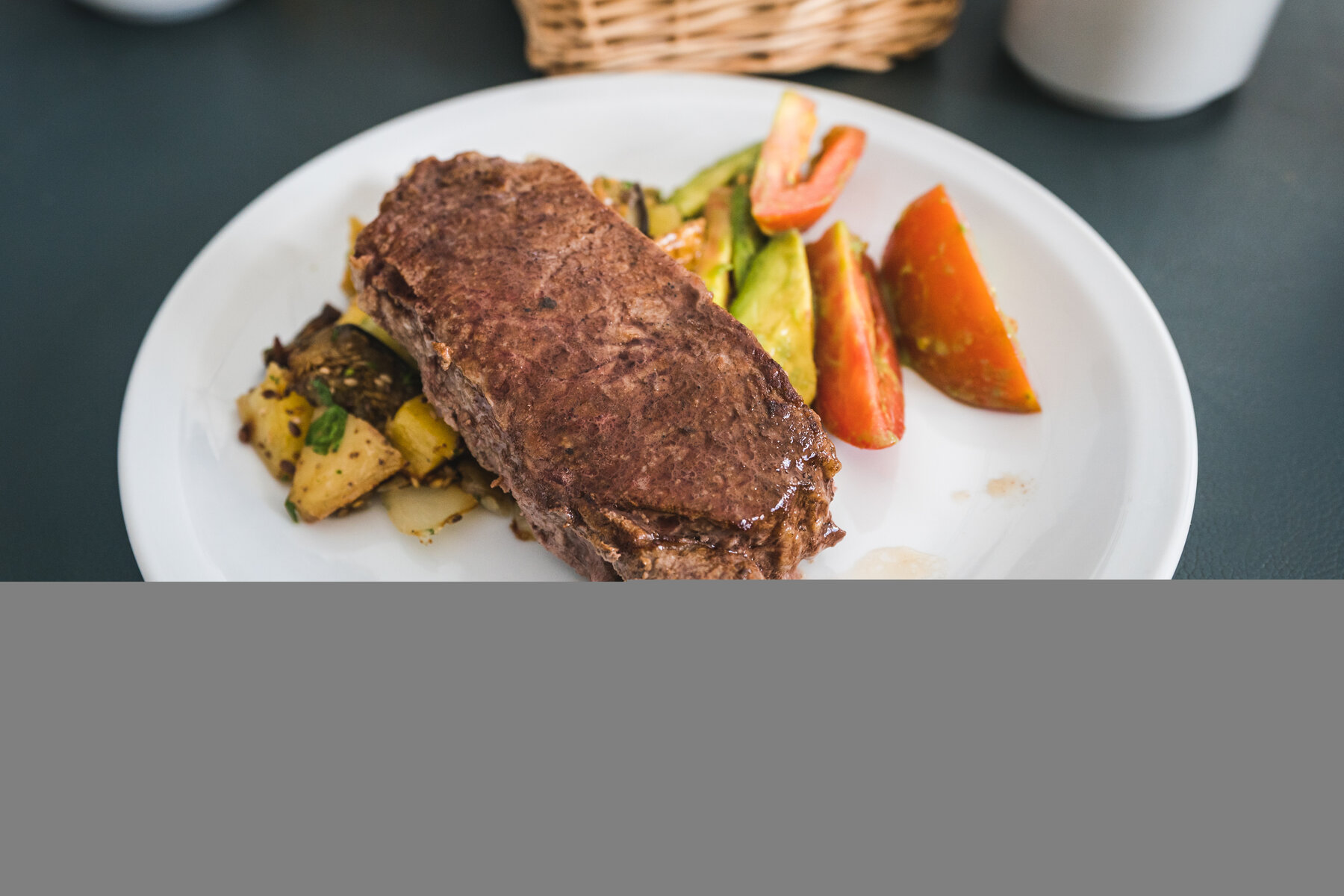
Argentine steak with roasted potatoes and sliced tomato on a white plate — Mendoza pre-expedition dinner
Dinner in Mendoza before the drive to the trailhead. Argentine beef, one last proper meal.
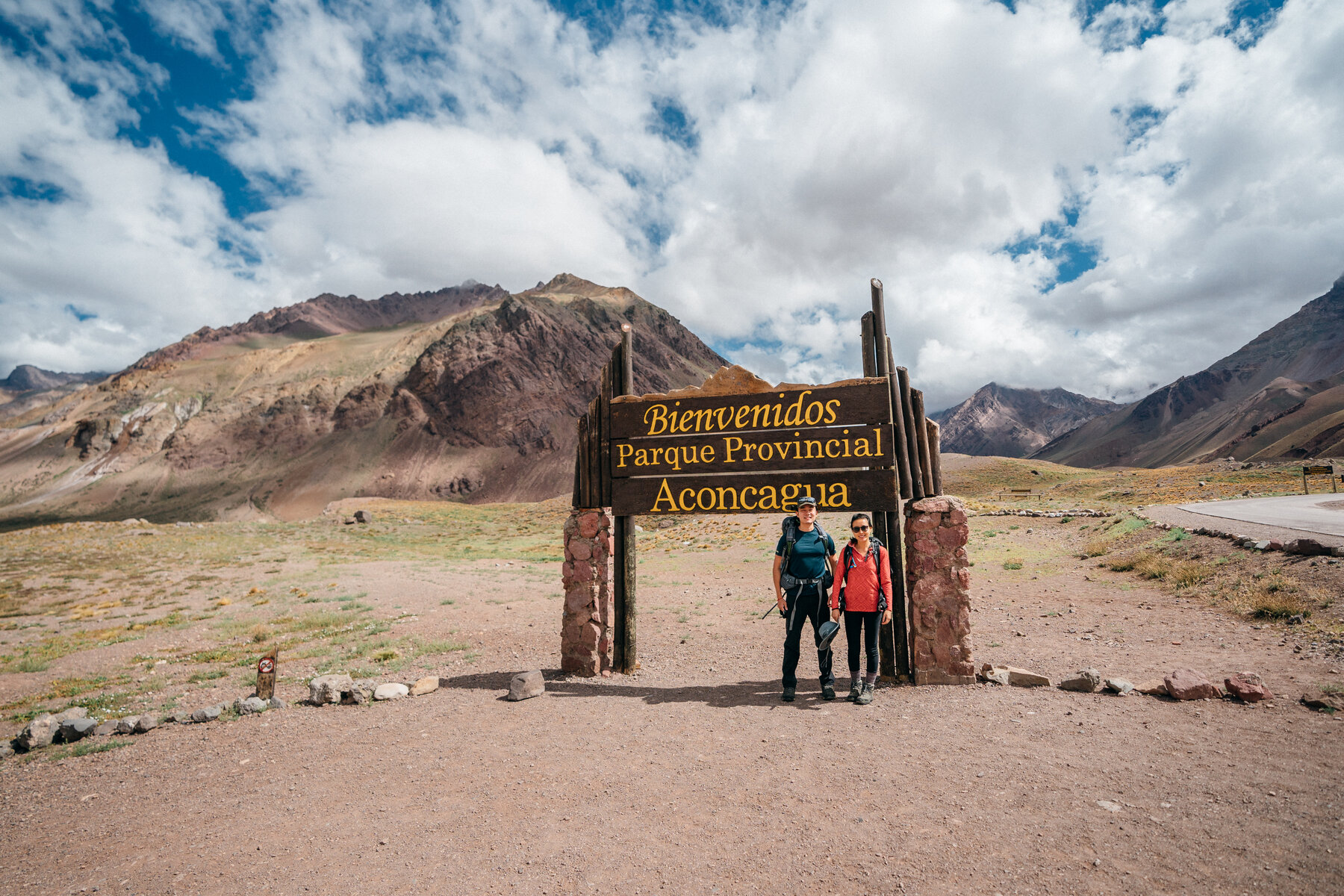
Jason and Grace at the Aconcagua Provincial Park entrance sign with snow-capped peaks behind
Jason and Grace at the Aconcagua Provincial Park entrance. The adventure starts here.

The trek begins at the Horcones Valley trailhead, where you pass through the park ranger station, show your permits, and start walking. The landscape is immediately striking: dry, rocky, and completely barren. No trees, no grass, just red and brown earth stretching out toward enormous snow-covered peaks. It looks more like Mars than anything you'd expect in South America.

The first couple of days are a gentle approach through the Horcones Valley to Confluencia Camp at 3,400 meters. The pace is deliberately slow, giving your body time to start adjusting to the altitude. Mule trains carry the bulk of your gear, so you're hiking with a lighter day pack, which makes the walking itself almost pleasant. The views, though, are anything but ordinary.
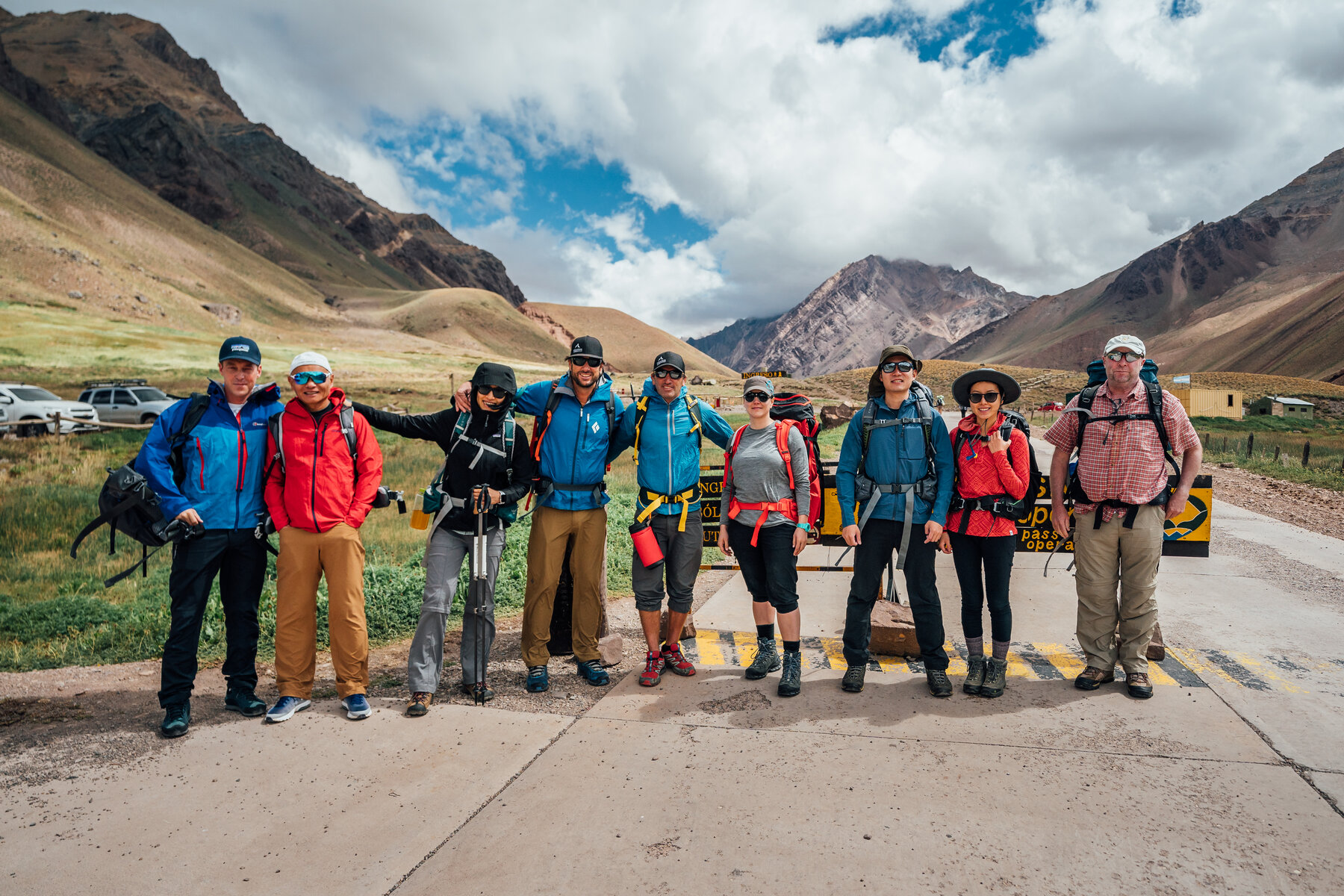
Our expedition team lined up at the Aconcagua park entrance, packs on and ready to start the approach
Team photo at the trailhead. Packs on, permits stamped, ready for the walk in.
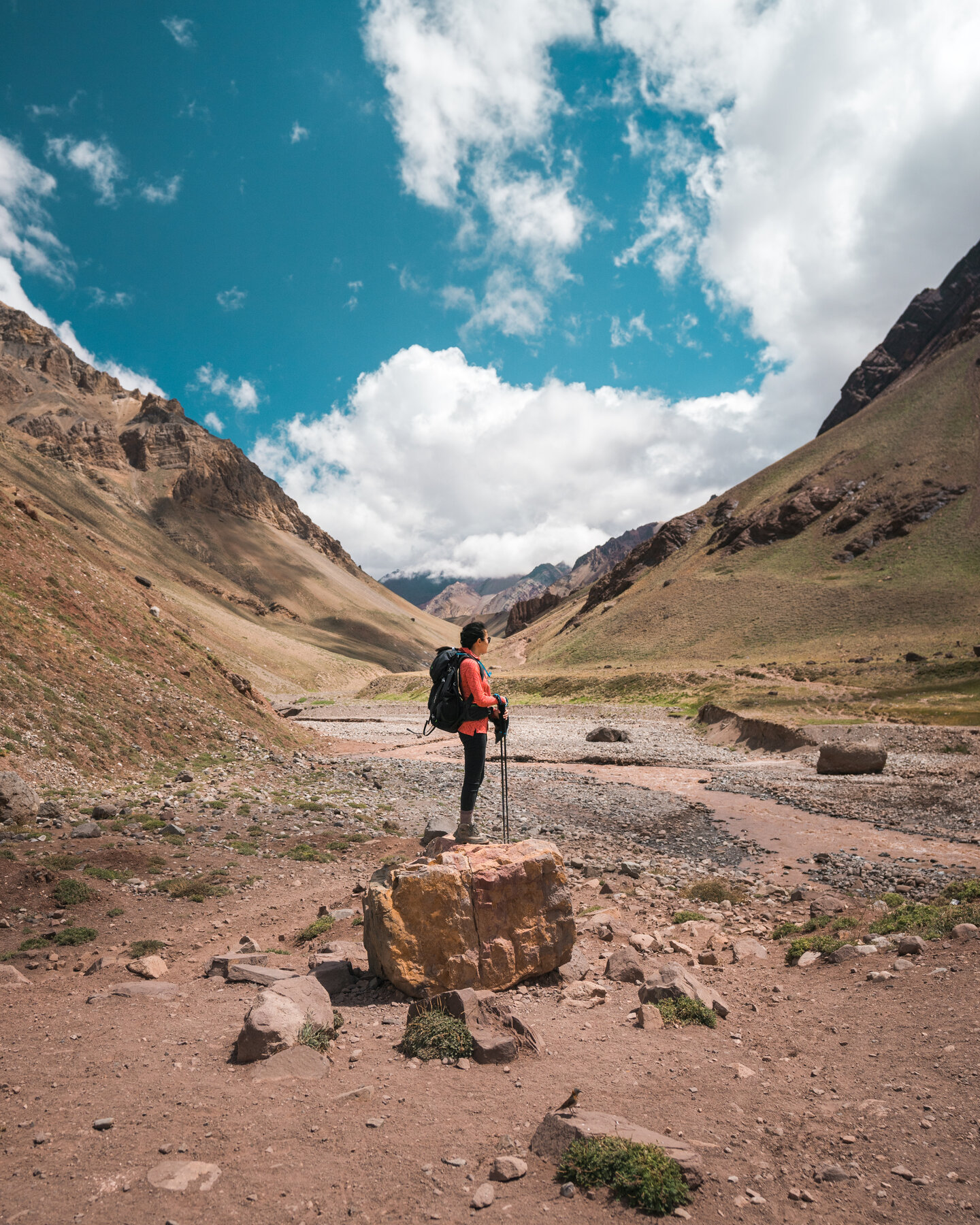
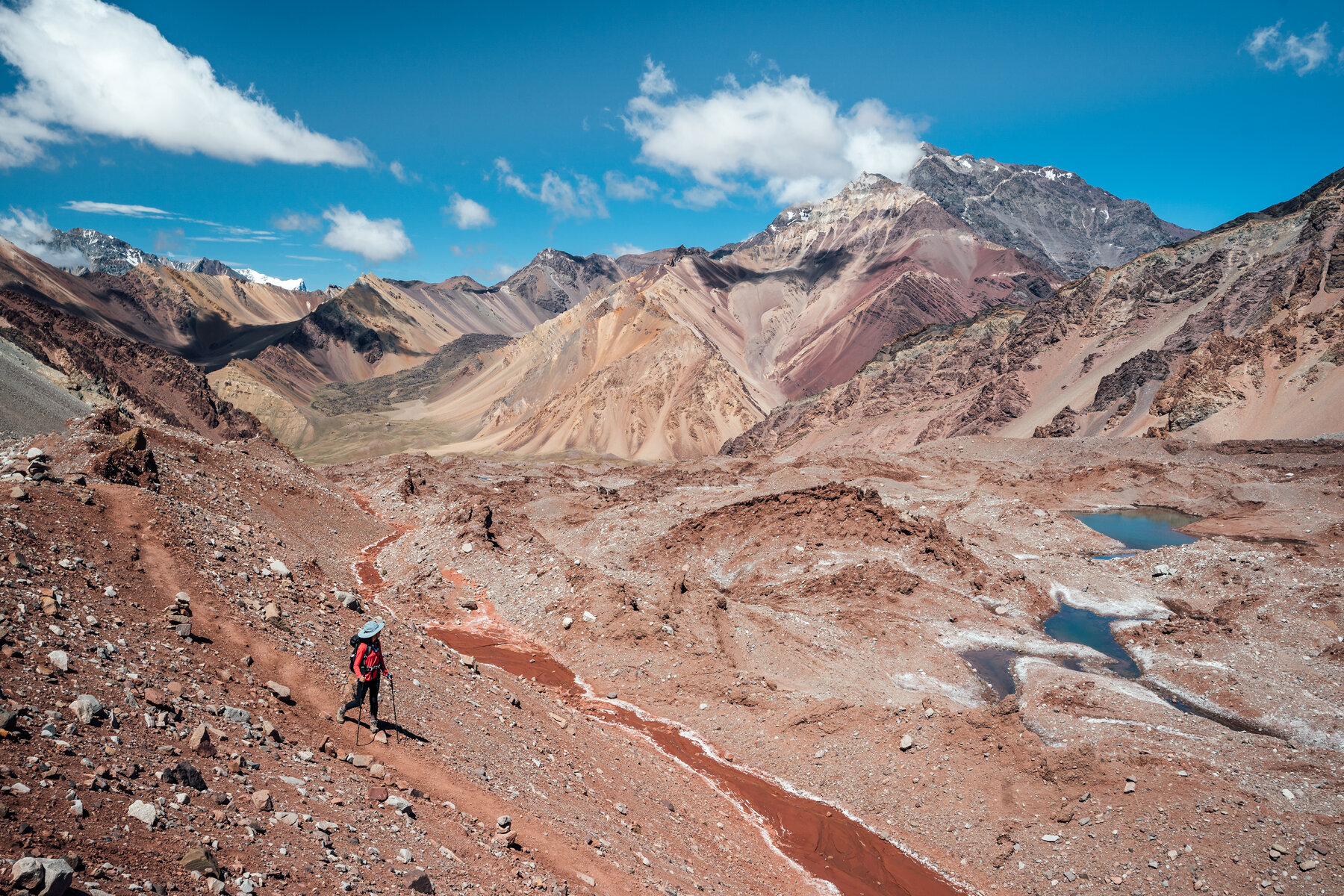
Lone climber with trekking poles walking a trail through the wide Horcones Valley, colorful layered mountains and a braided river ahead
The Horcones Valley opens up. Nothing but rock, sky, and silence.
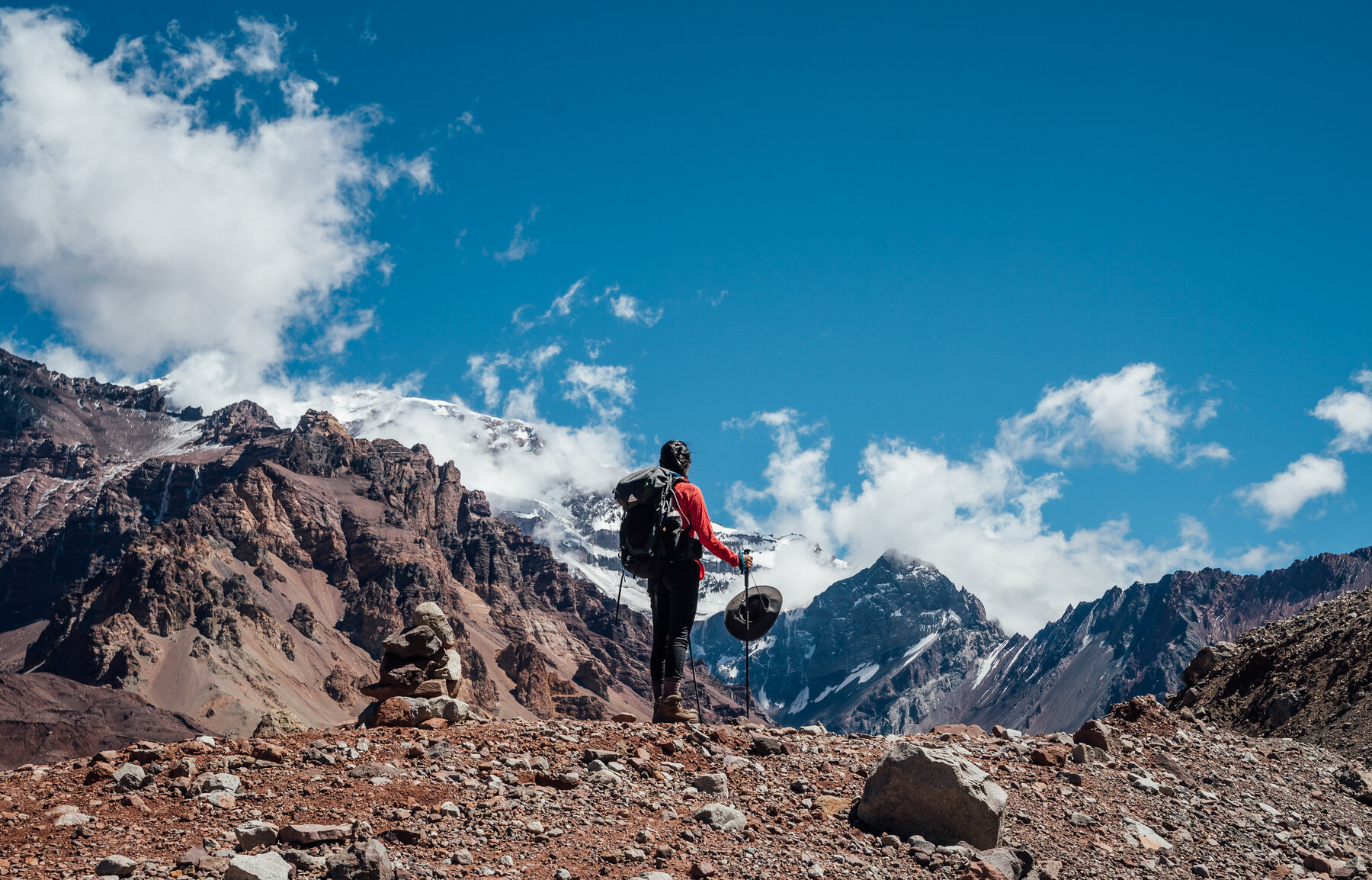
Climber in red jacket looking up at the snow-dusted summit of Aconcagua from the approach trail
First proper view of the summit from the approach. It looks impossibly far up there.
Lone climber walking through the colorful rock-layered Confluencia valley
Colored rock layers flanking the Confluencia valley, pure solitude on the trail.
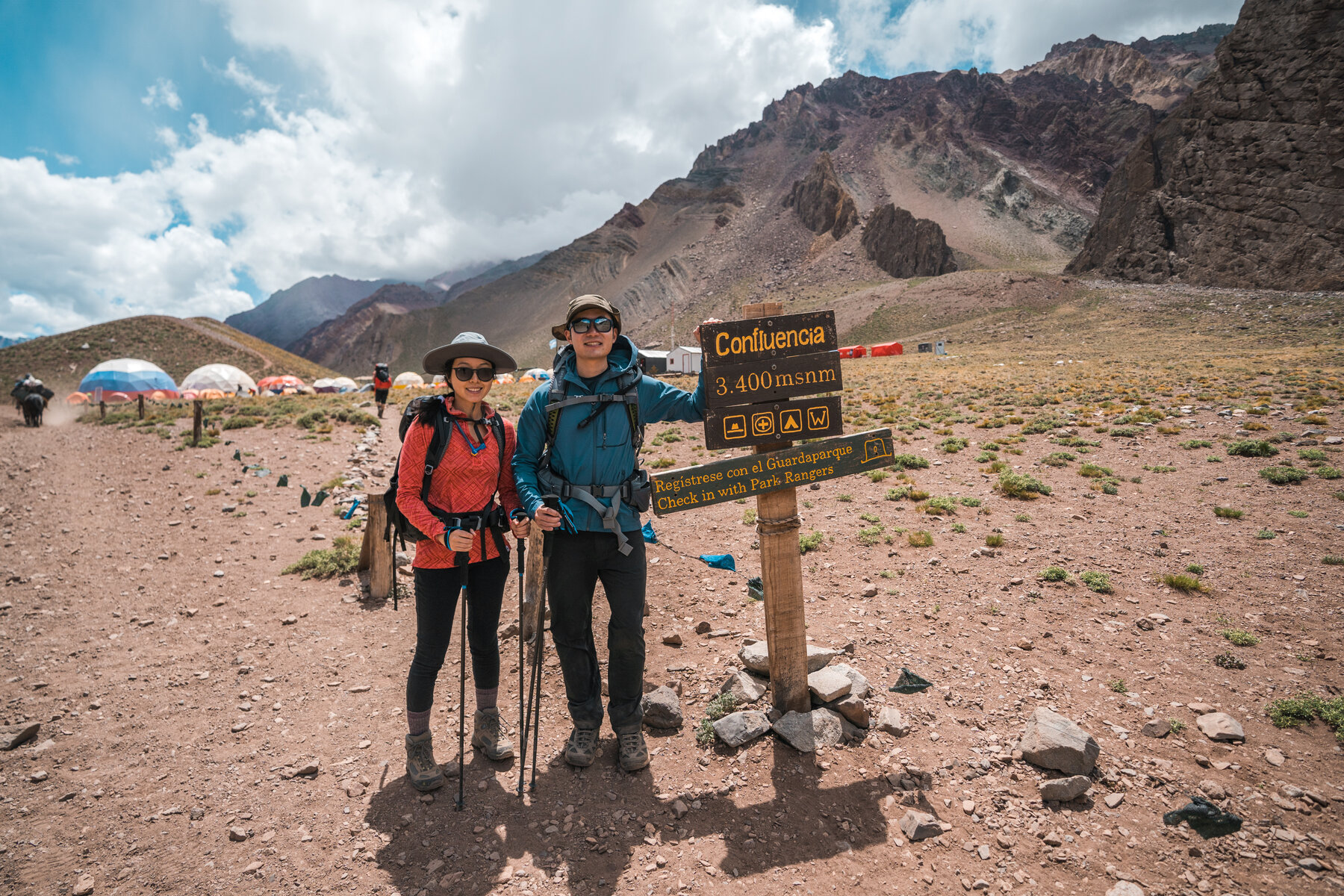
Jason and Grace at the Confluencia Camp waypoint sign with colorful tents behind
Arriving at Confluencia Camp. Tents dotting the valley floor, Aconcagua towering above.

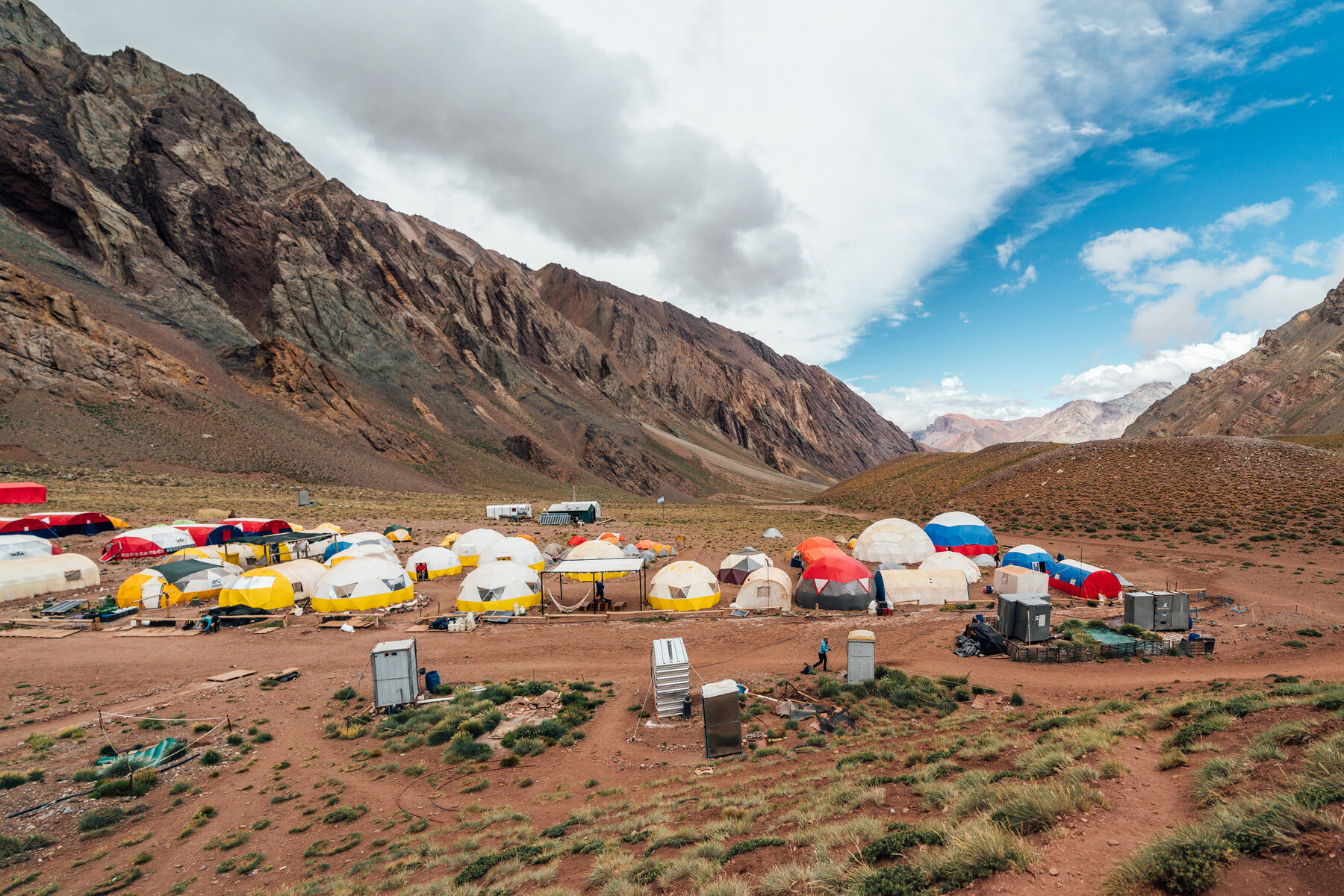
Confluencia Camp is the first real stop on the mountain, a colorful cluster of expedition tents spread across a gravelly plateau at the junction of two valleys. We spent a rest day here doing an acclimatization hike toward Plaza Francia (4,000 m), the south face viewpoint, gaining altitude during the day and sleeping low at night. The south face of Aconcagua from this angle is one of the most dramatic walls of rock and ice you'll ever see.
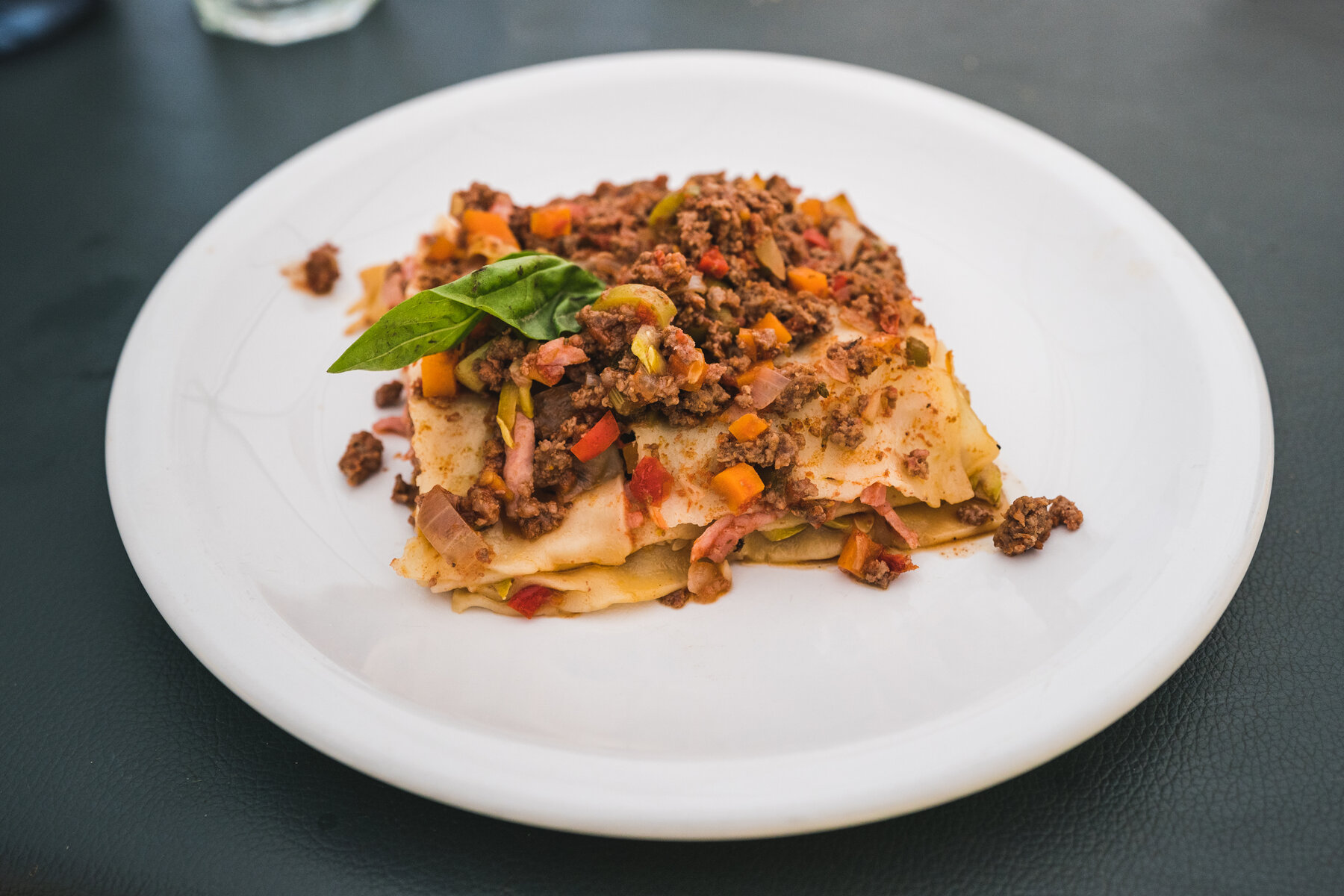
A hearty plate of lasagna served during the Aconcagua expedition
Camp fuel. The expedition meals kept us going through long days on the trail.
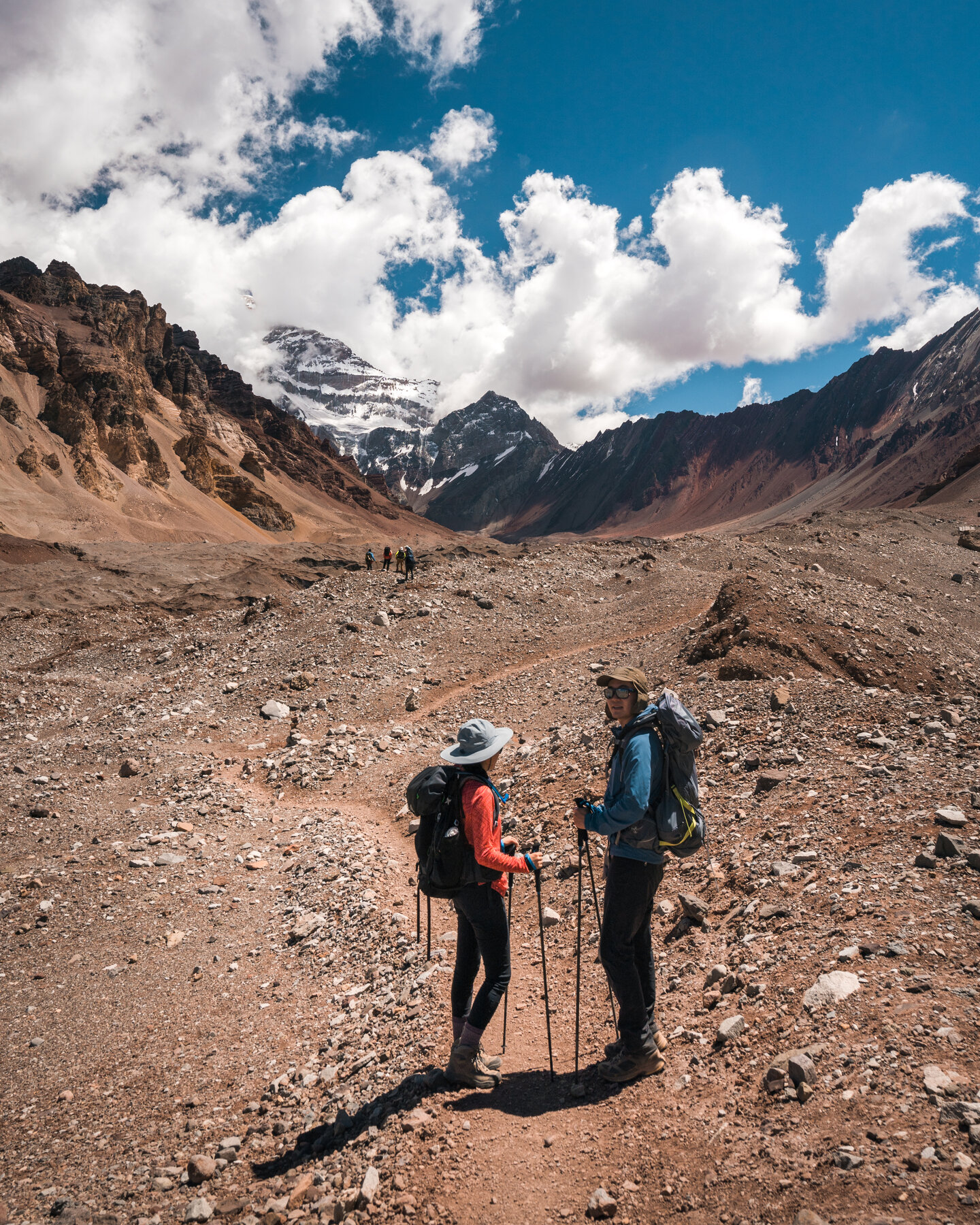
Jason and Grace trekking toward snow-capped Andean peaks
Trekking toward the peaks. The Andes revealing themselves one valley at a time.
Panoramic view of Confluencia Camp with colorful tents and dramatic canyon walls
Confluencia Camp from above. Canyon walls, colored rock layers, and expedition tents everywhere.

Days 4–7: Plaza de Mulas Base Camp

February 4–7, 2019 · Confluencia → Plaza de Mulas · 4,400 m / 14,400 ft

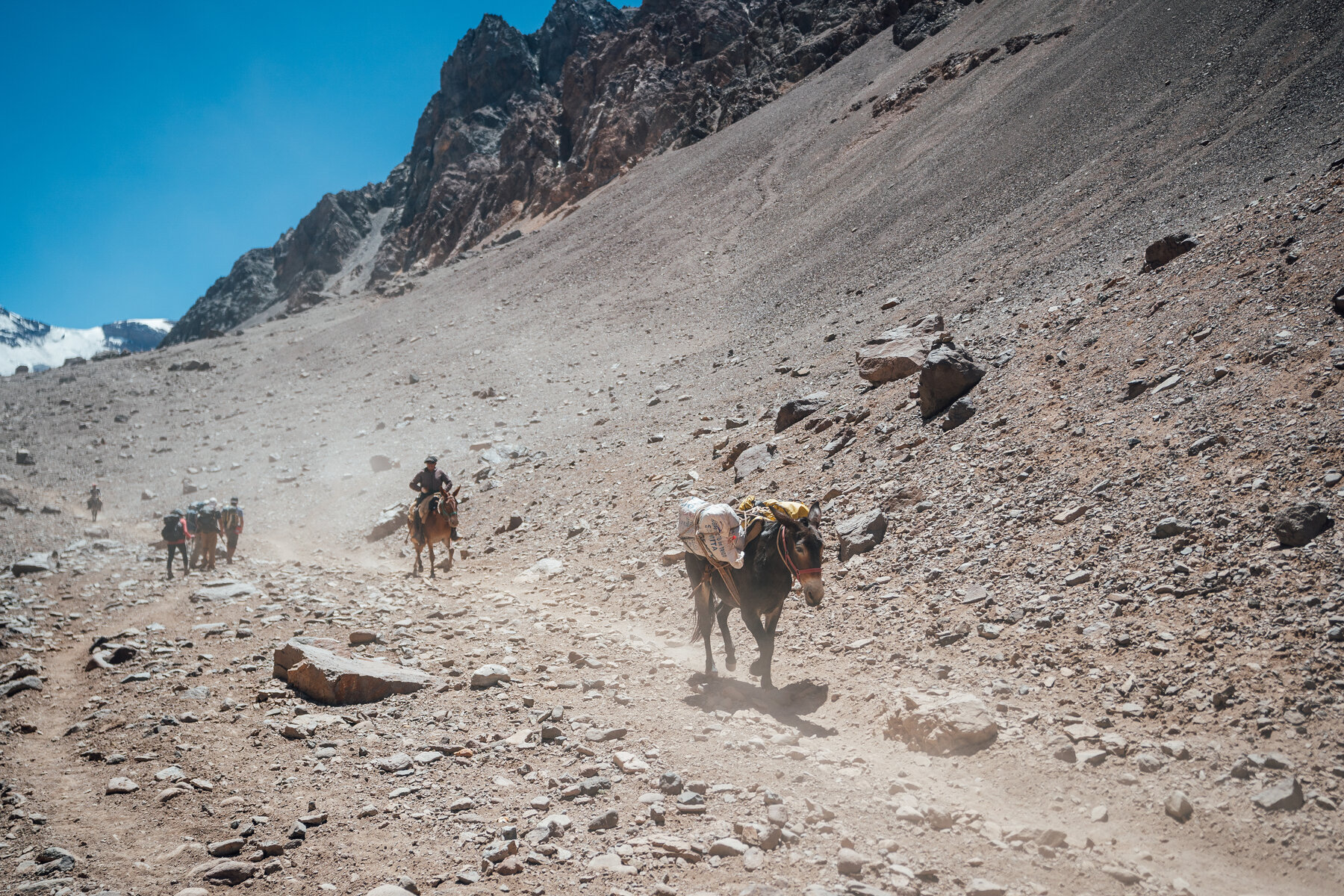
The trek from Confluencia to Plaza de Mulas is a long day through increasingly barren terrain. The mule trains are your lifeline here, hauling duffel bags and equipment up the valley while you focus on putting one foot in front of the other. The final stretch involves a seemingly endless series of switchbacks up a loose moraine before the camp finally comes into view.

Mule train carrying expedition gear up scree slopes toward higher camps
The mule trains doing the heavy lifting. Without them, none of this would be possible.

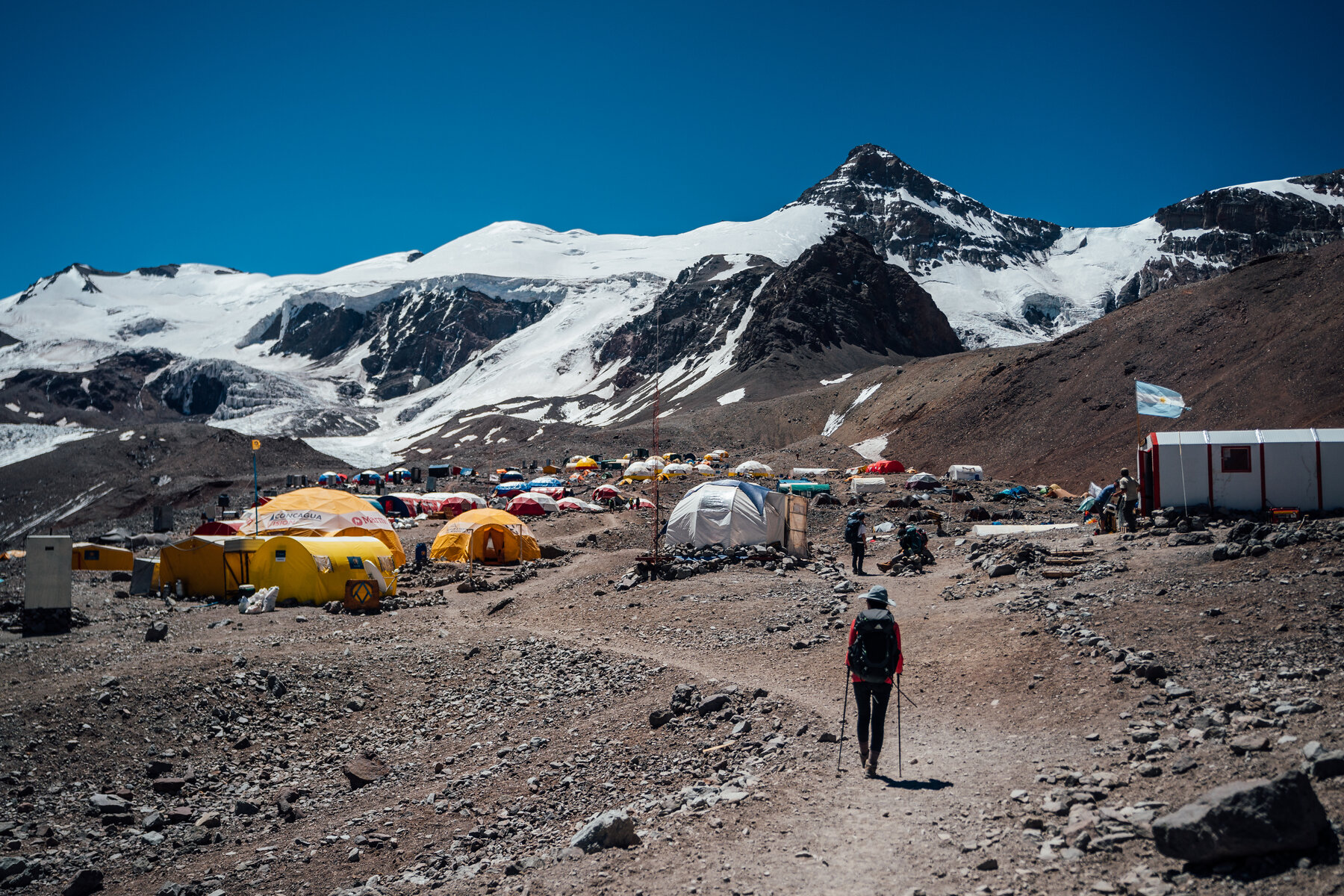
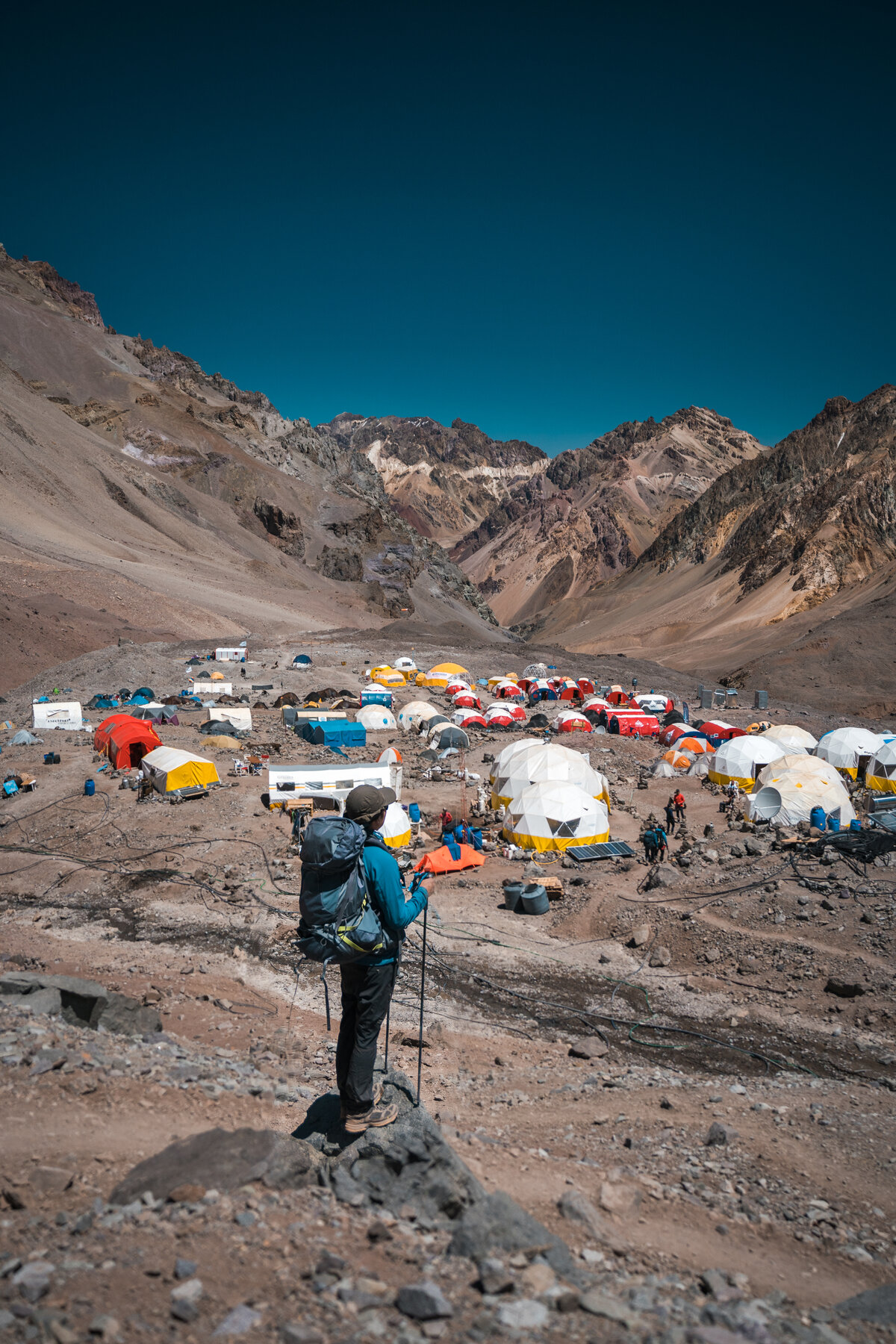
Plaza de Mulas is the largest base camp in the Andes and one of the biggest in the world. At 4,400 meters it's a sprawling tent city with dozens of expedition groups, a medical tent, and even a small hotel-like structure run by one of the outfitters. It's where you'll spend several days resting, acclimatizing, and preparing for the push to higher camps. From here, you can see the summit of Aconcagua directly above, and that visual connection makes it all feel very real.

Sprawling Plaza de Mulas base camp with colorful tents and glaciers in the background
Plaza de Mulas. The largest base camp in the Andes, and home for the next several days.
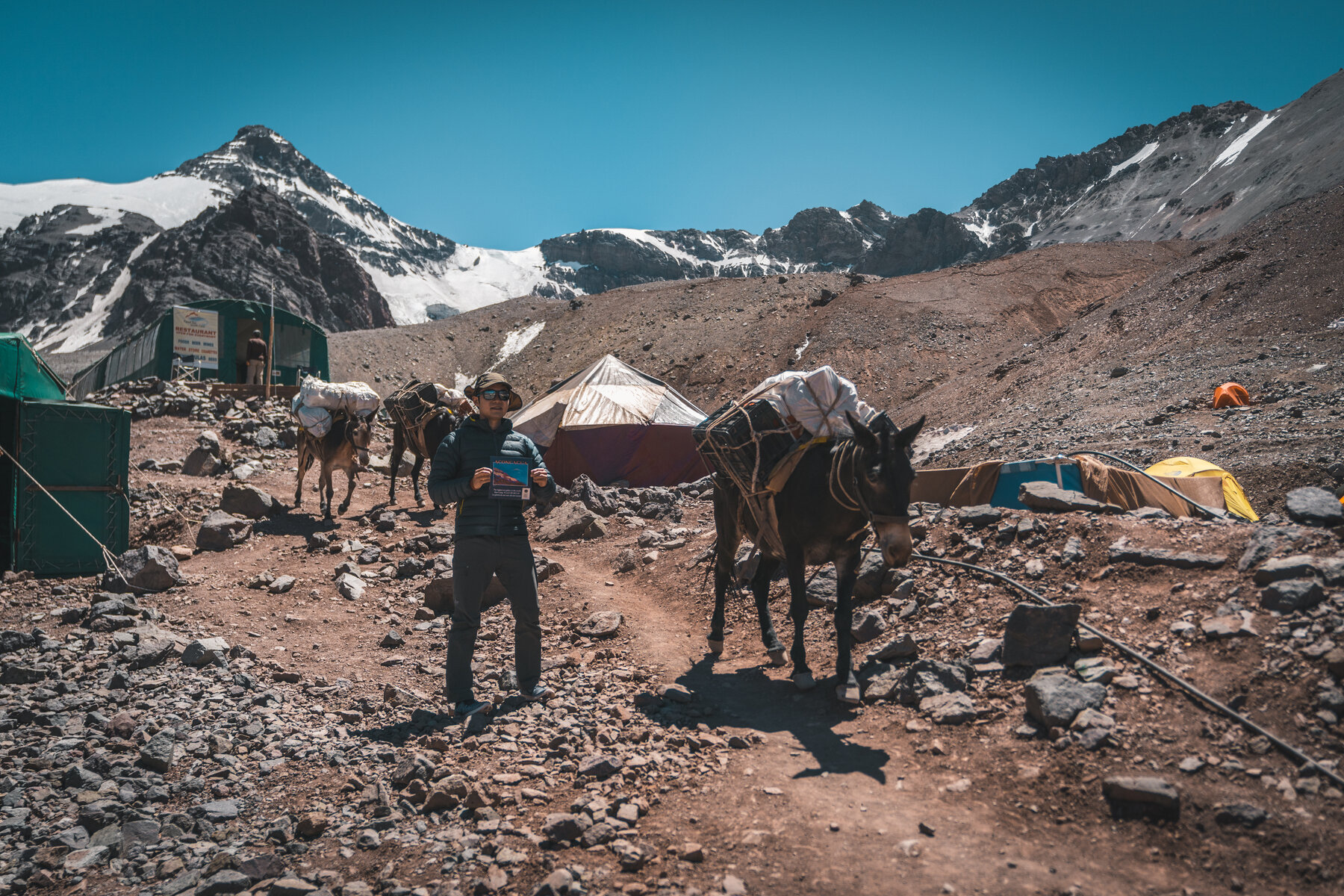
Mule handler with pack mules at Plaza de Mulas base camp with glaciated peaks behind
A mule handler and his pack mules at base camp. These teams haul everything up the valley so climbers can focus on the mountain.
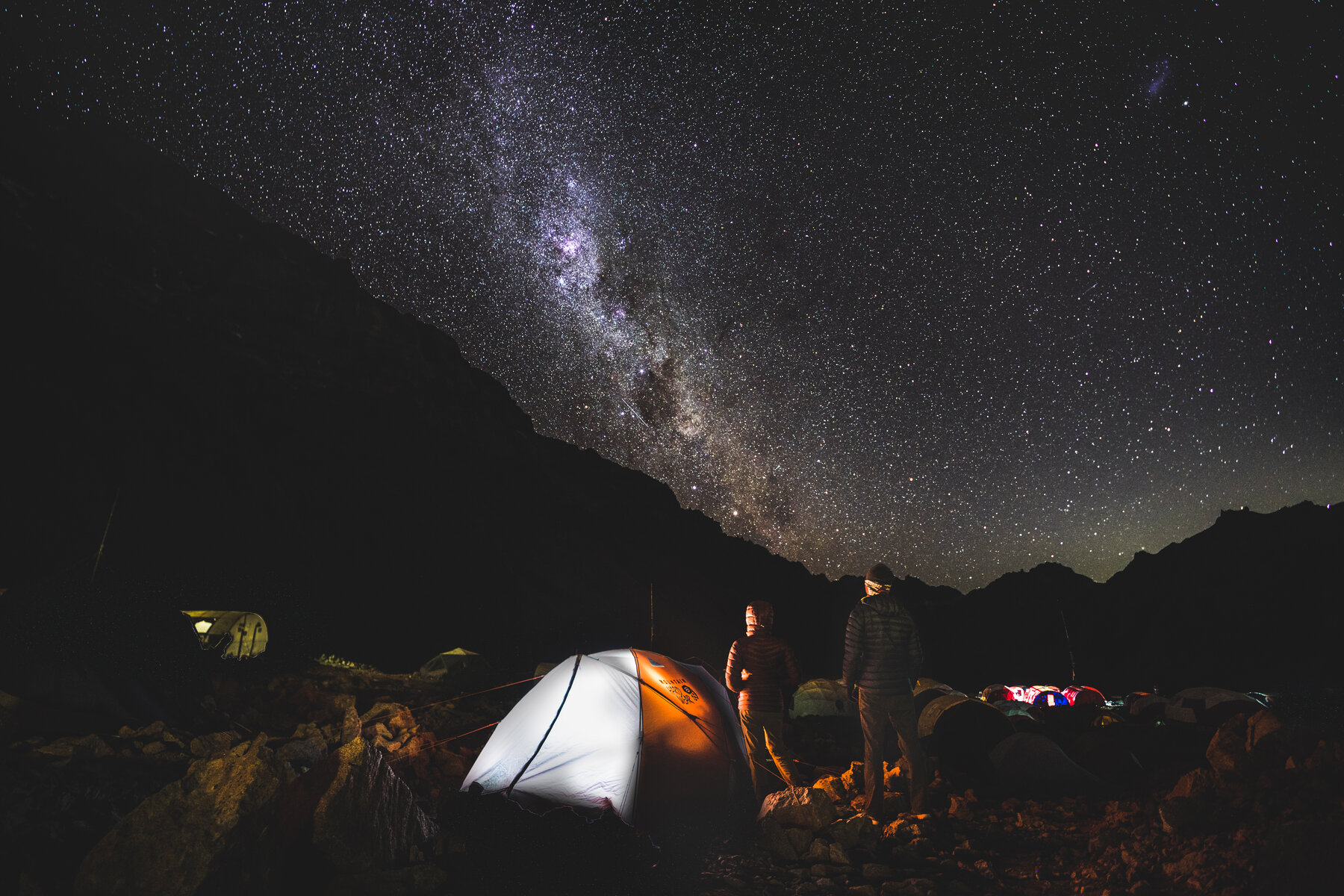
The Milky Way stretching over camp with a glowing tent and two climbers standing outside
The Milky Way over camp. No light pollution at this altitude, just stars in every direction.

We spent three days at Plaza de Mulas acclimatizing, eating as much as we could, and mentally preparing. The altitude at 4,400 meters is noticeable: headaches, shortness of breath, and disrupted sleep are normal. But each day your body adapts a little more. Go high, sleep low. The same principle as Kilimanjaro, just with much higher stakes.

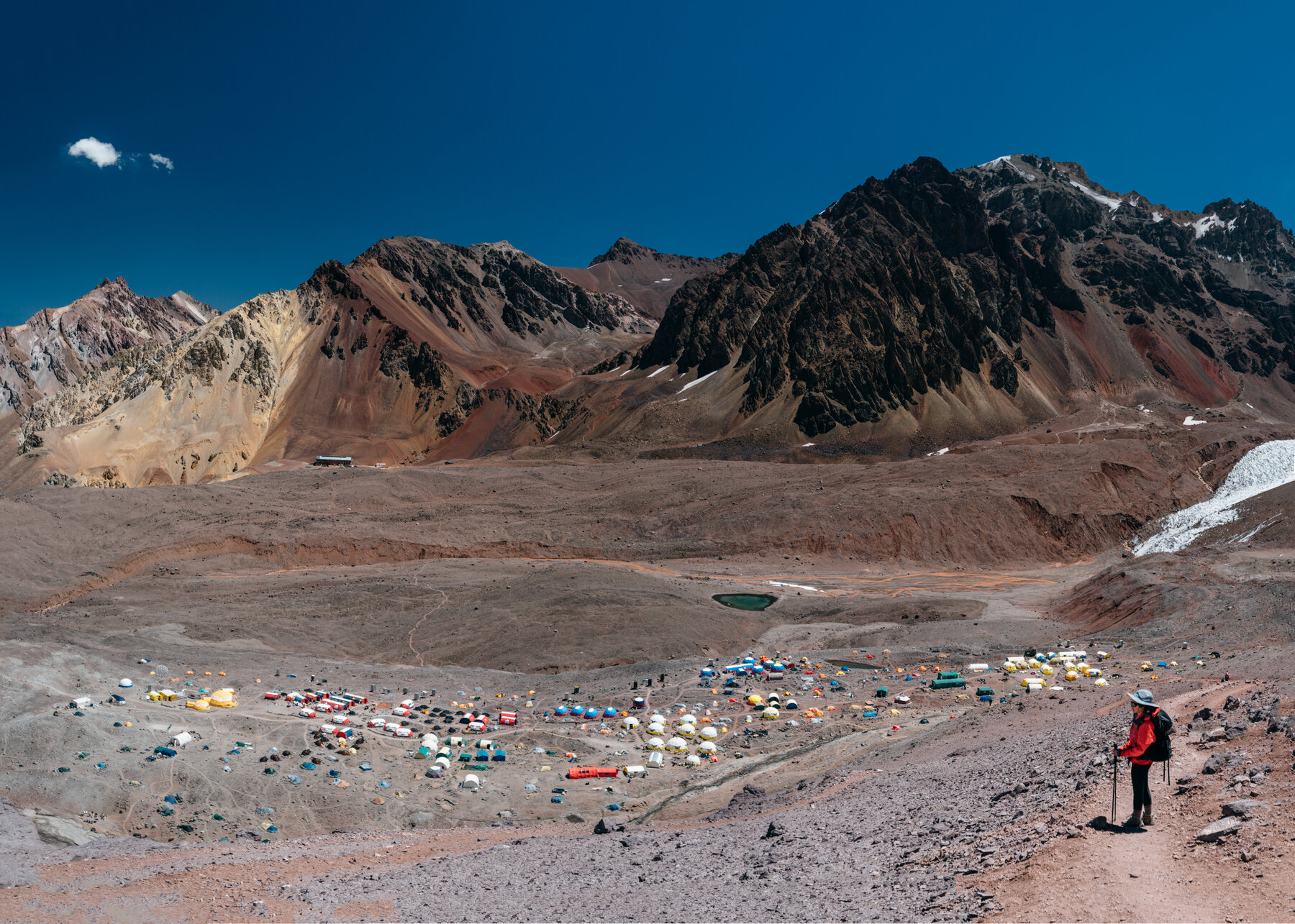
Climber standing on a ridge overlooking the sprawling Plaza de Mulas base camp below
Looking down at Plaza de Mulas from above. The sprawl of expedition tents gives a sense of scale.
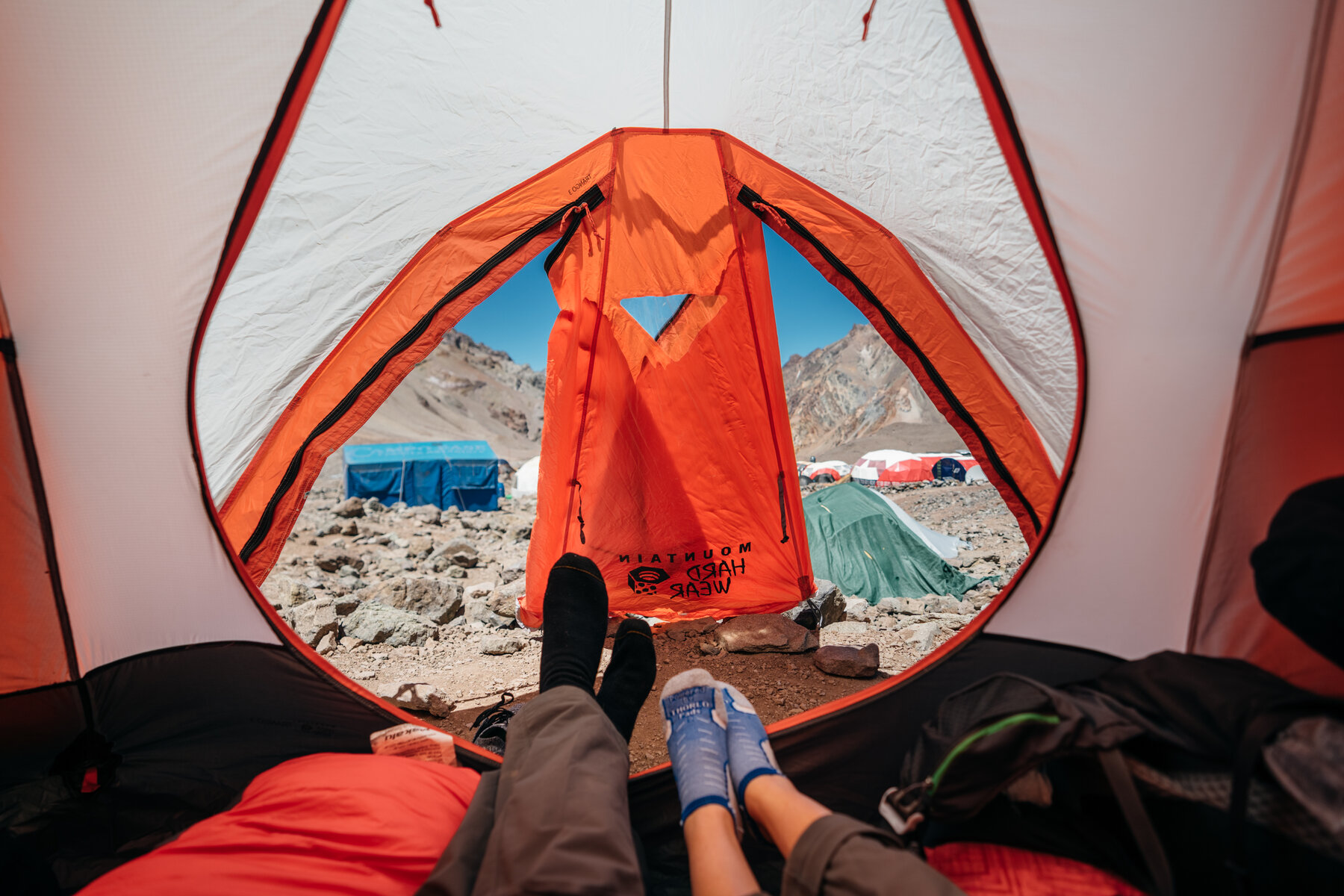
View from inside an orange tent looking out at other tents and mountains at base camp
The view from inside the tent. Kicking back after a long acclimatization day at base camp.
Panoramic view of Plaza de Mulas base camp and surrounding Andes peaks
The full panorama from Plaza de Mulas. Expedition tents, glaciated peaks, and the route to the summit stretching above.

Days 8–12: Camps 1, 2, and 3

February 8–12, 2019 · Camp 1 – Canadá (5,000 m) → Camp 2 – Nido de Cóndores (5,500 m) → Camp 3 – Cólera (5,930 m / 19,450 ft)

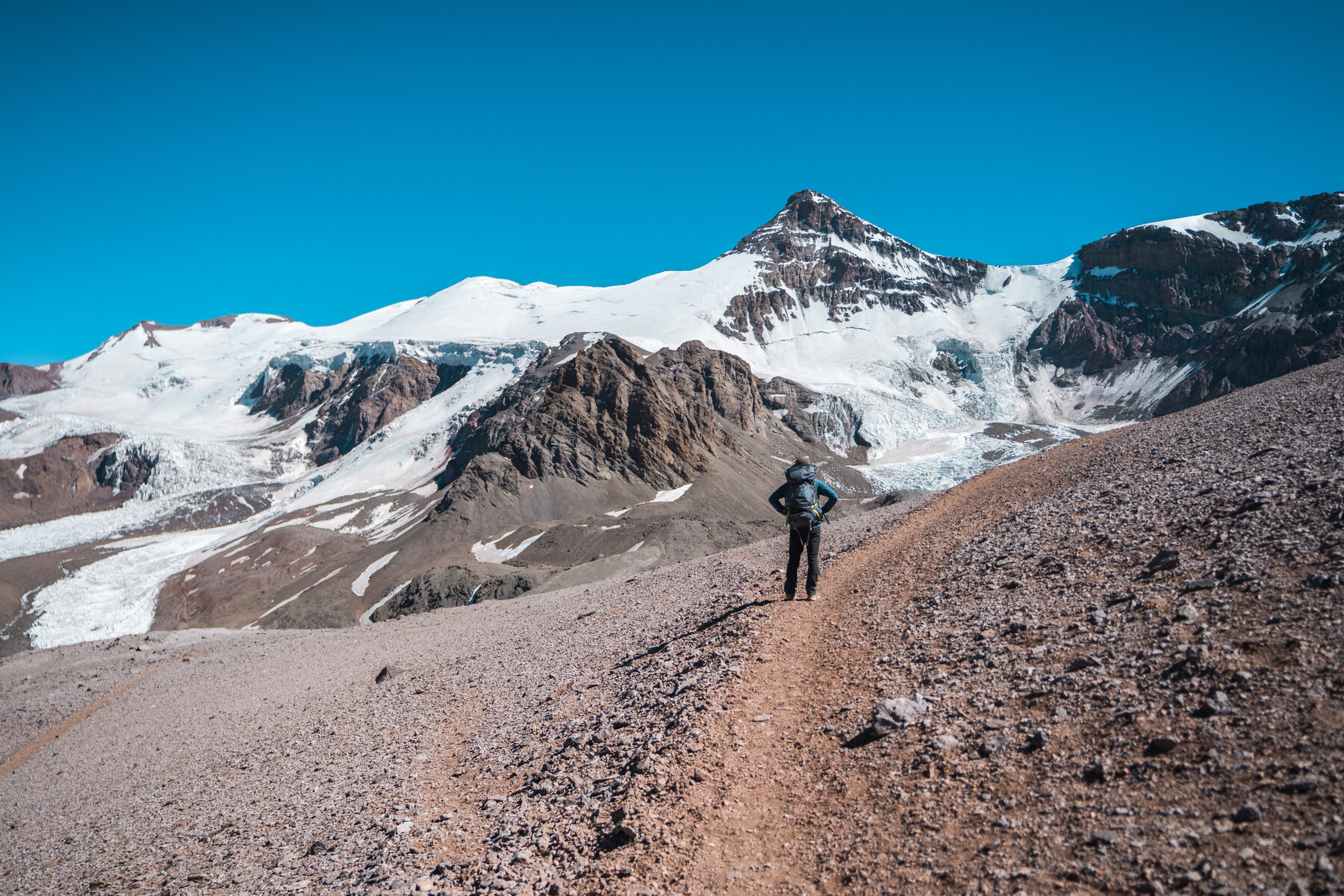
This is where the mountain gets serious. Above base camp, the terrain shifts to endless scree fields, loose rock, and steep switchbacks. Each day you carry loads to the next camp, cache gear, and come back down to sleep. Then the next day you move up for good. It's exhausting, repetitive work, but it's the only way to safely acclimatize to these altitudes.

Climber on steep scree slope with glaciated peaks in background
The grind above base camp. Loose scree, thin air, and a long way still to climb.

Camp 1 (Canadá) sits at 5,000 meters, Camp 2 (Nido de Cóndores) at 5,500, and Camp 3 (Cólera) at 5,930. By the time you reach Camp 3, you're in the death zone's doorstep. Everything is harder: walking, breathing, thinking, sleeping. Your appetite disappears. The wind picks up. The cold is bone-deep and constant. But you keep moving because the summit is right there, visible from every camp, taunting you to come closer.

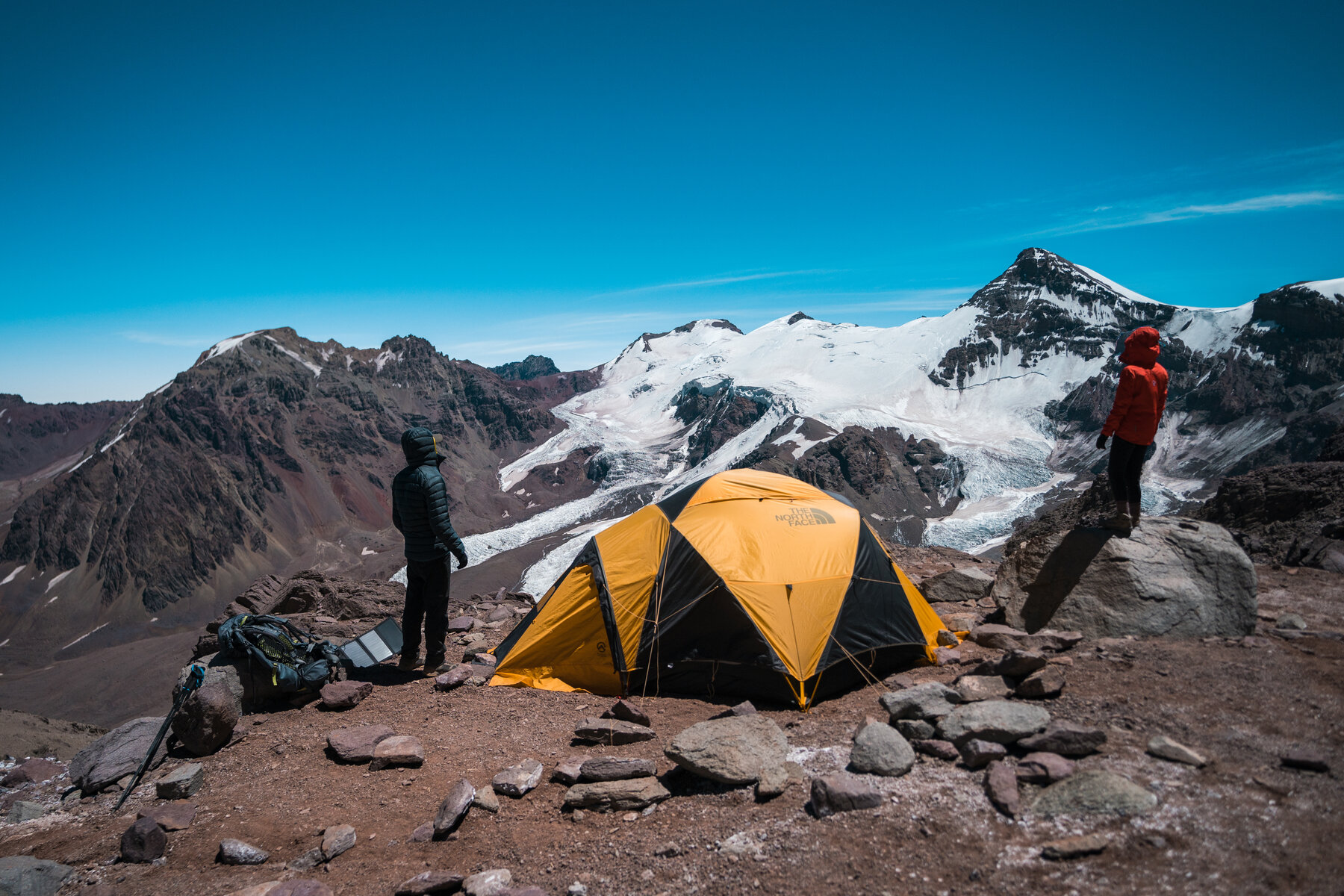
Two climbers at high camp with massive glaciated peaks behind
Setting up at high camp. Glaciated peaks stretching out behind us in every direction.
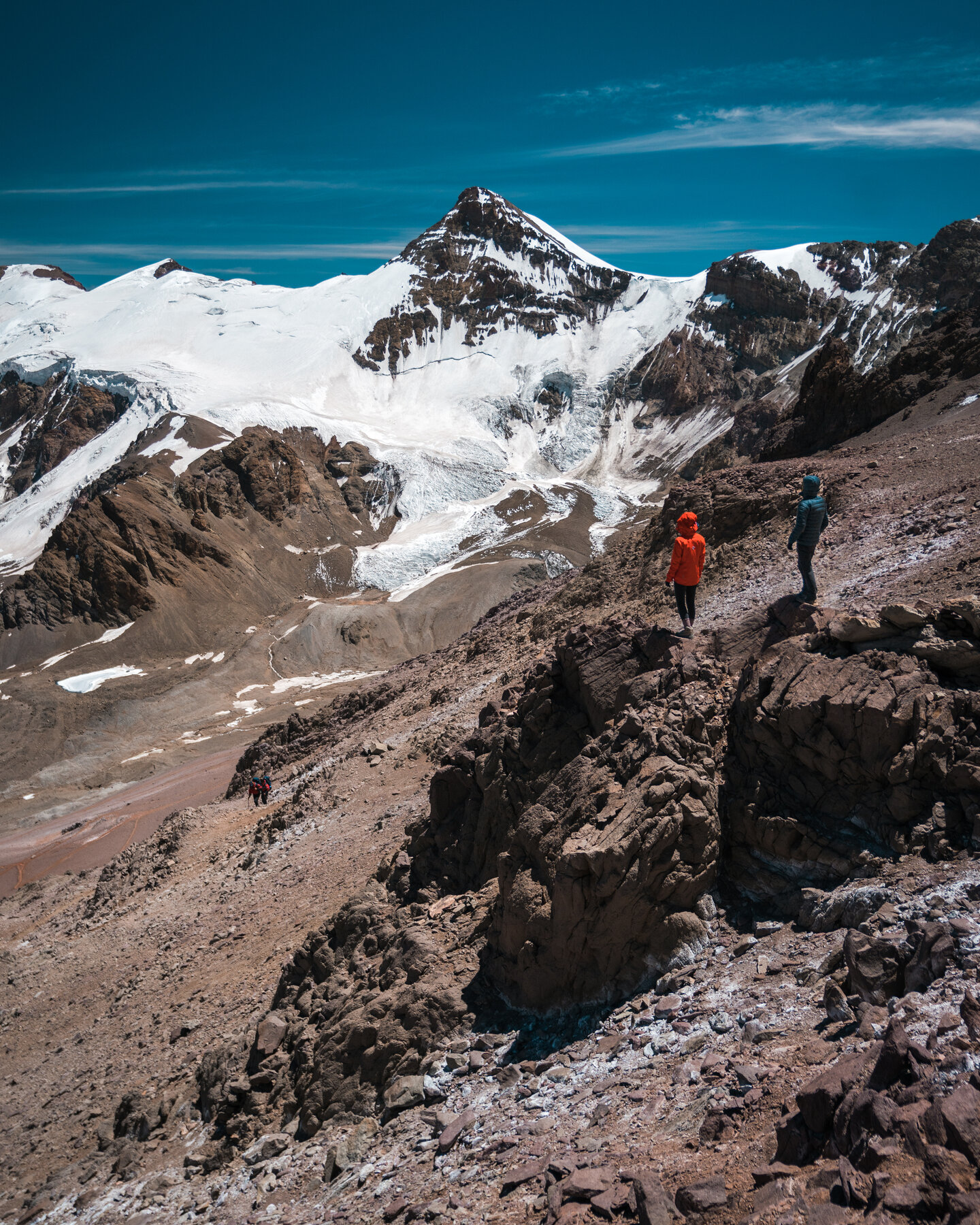
Two climbers standing on a rocky ridge with glaciated Aconcagua peaks towering behind
Pushing higher into the mountains. The glaciated peaks growing closer with every camp move.
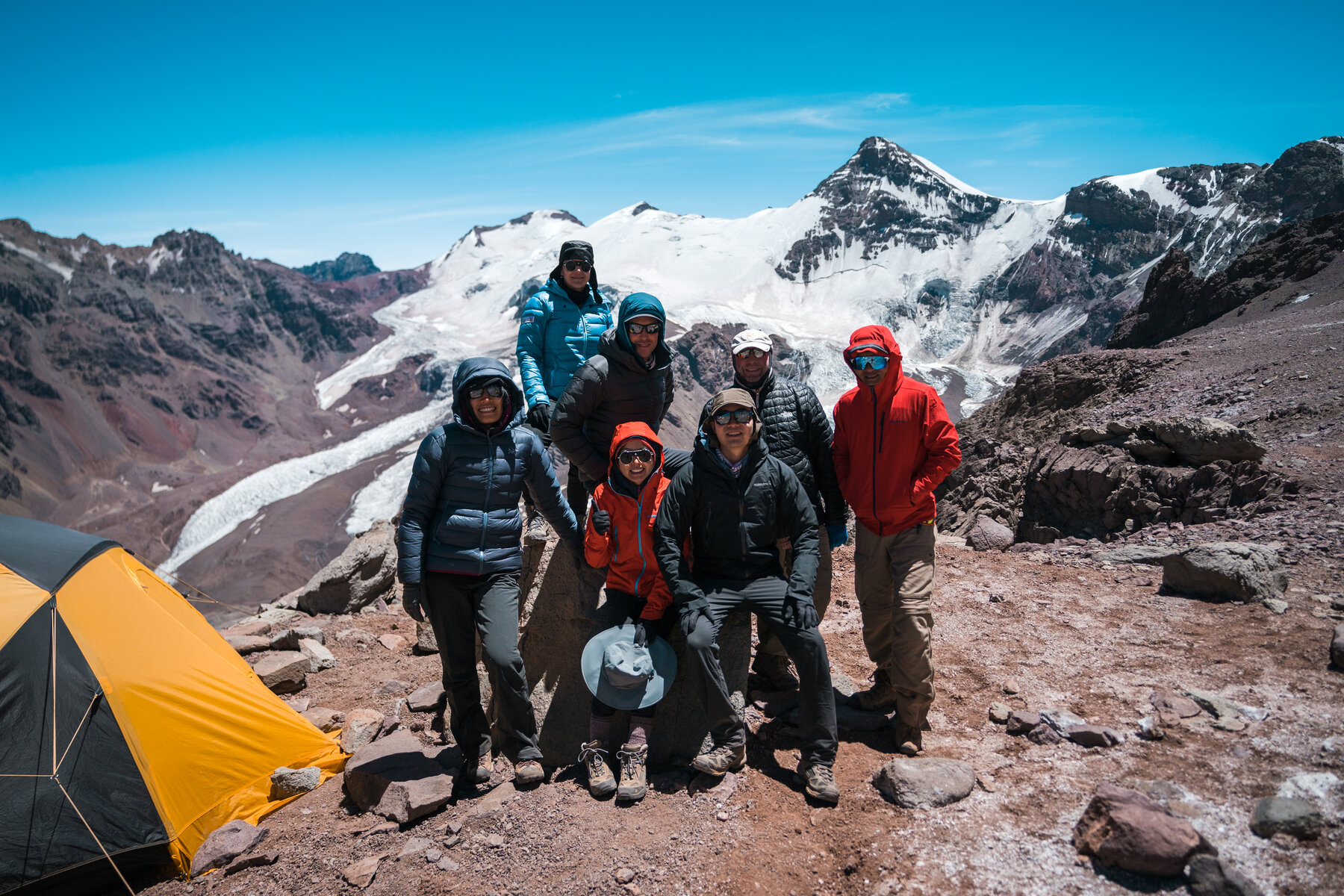
Full climbing team posing at high camp with Aconcagua summit behind
The team at high camp. Everyone still smiling, though the altitude is starting to show on our faces.
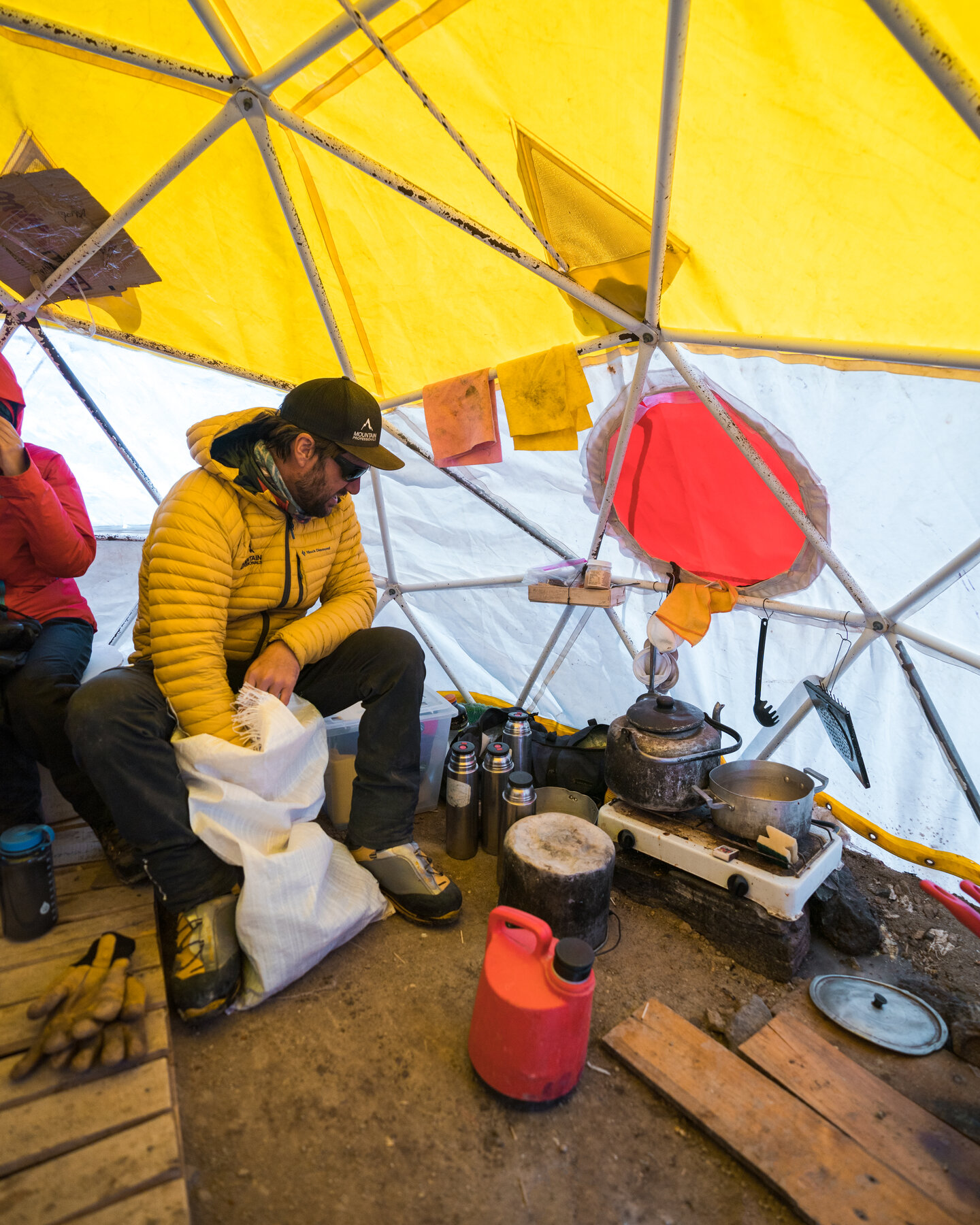
Expedition cook preparing a meal inside a yellow dome tent at high camp
Melting snow and boiling water at Camp 2. Hot meals at altitude are a lifeline.
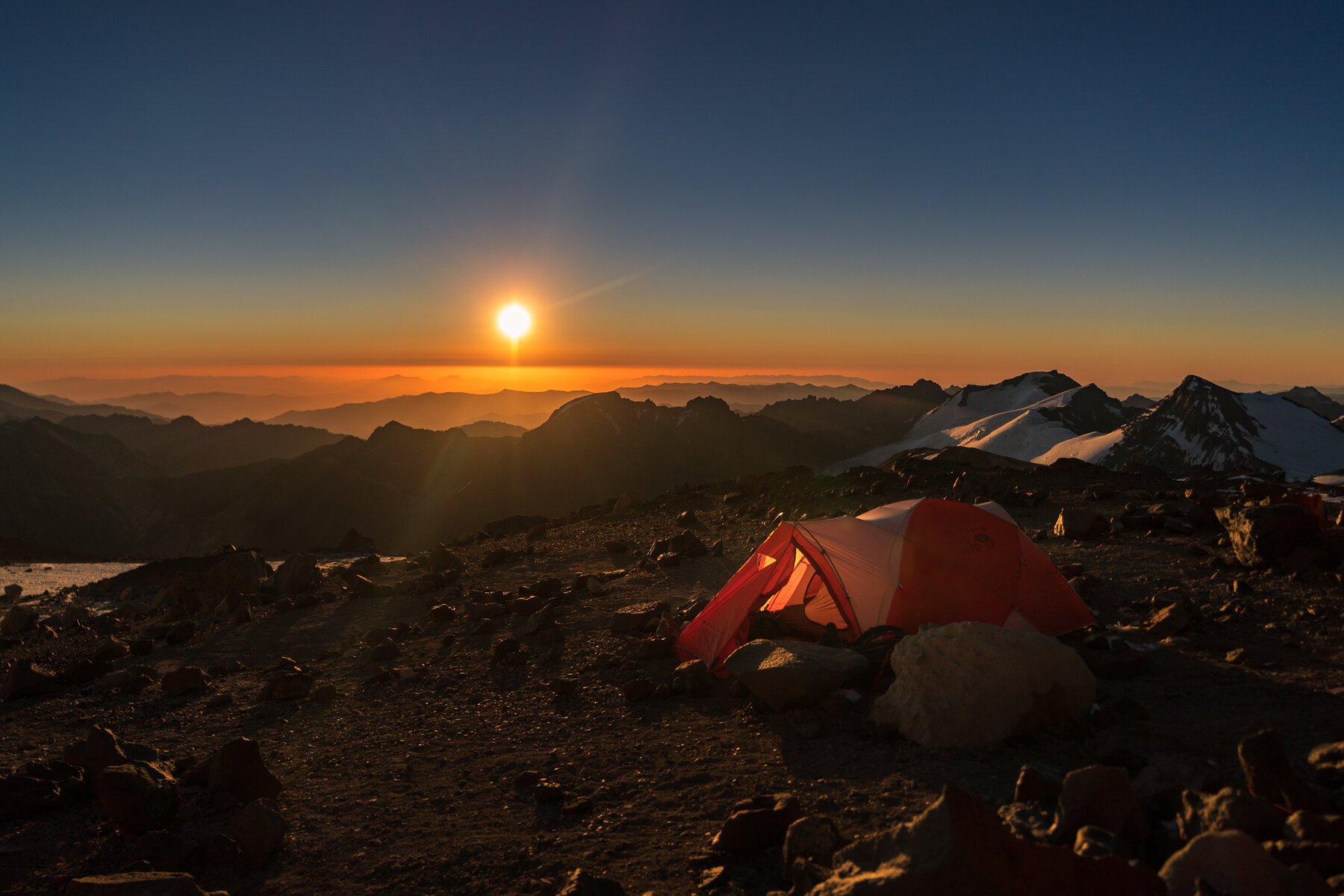
Glowing tent at sunset on Aconcagua with the sun setting over silhouetted mountain ridges
Sunset at high camp. The tent glowing against the fading light as another day on the mountain ends.
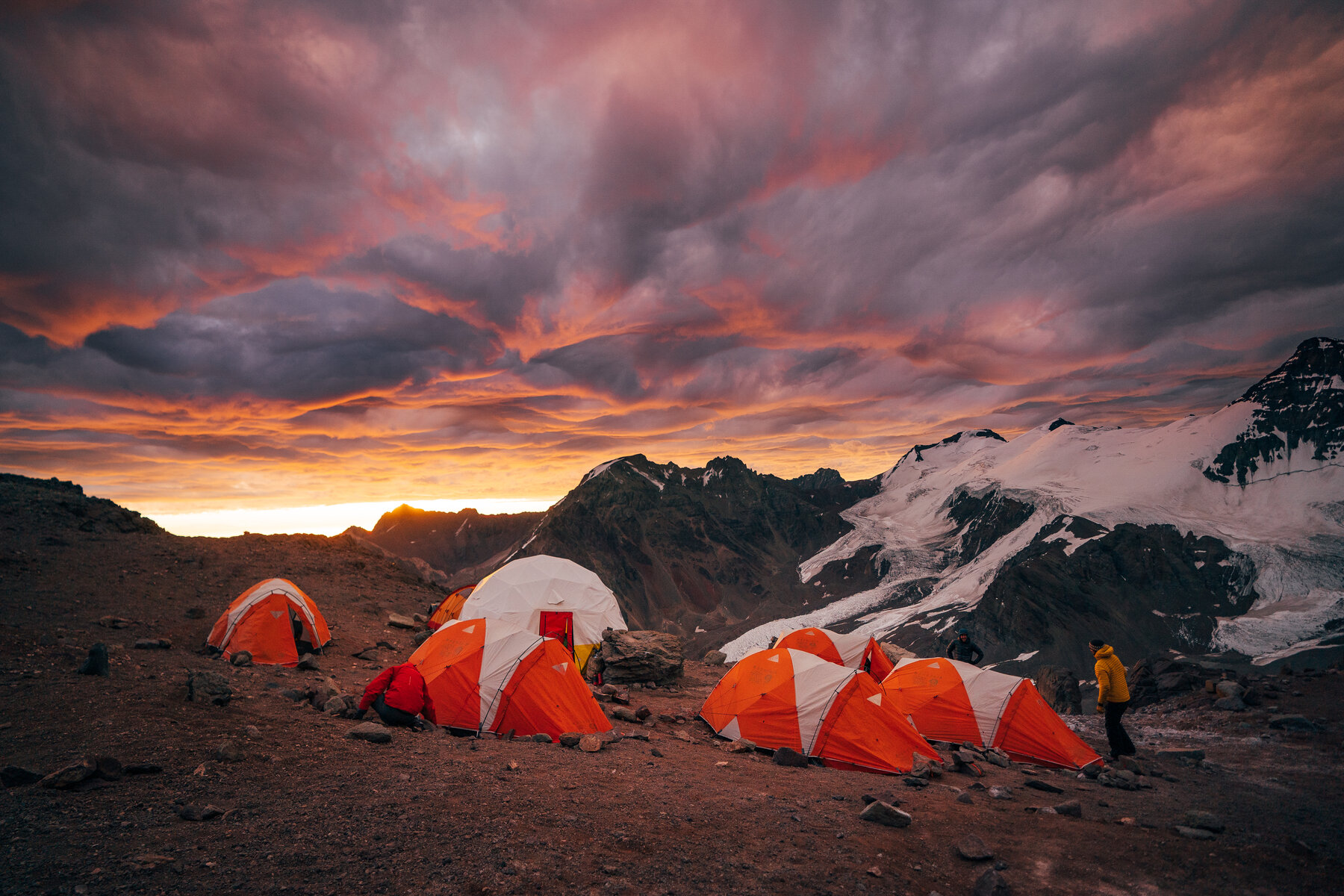
Dramatic sunset over high camp tents on Aconcagua
Evening at high camp. The sky puts on a show every evening up here.
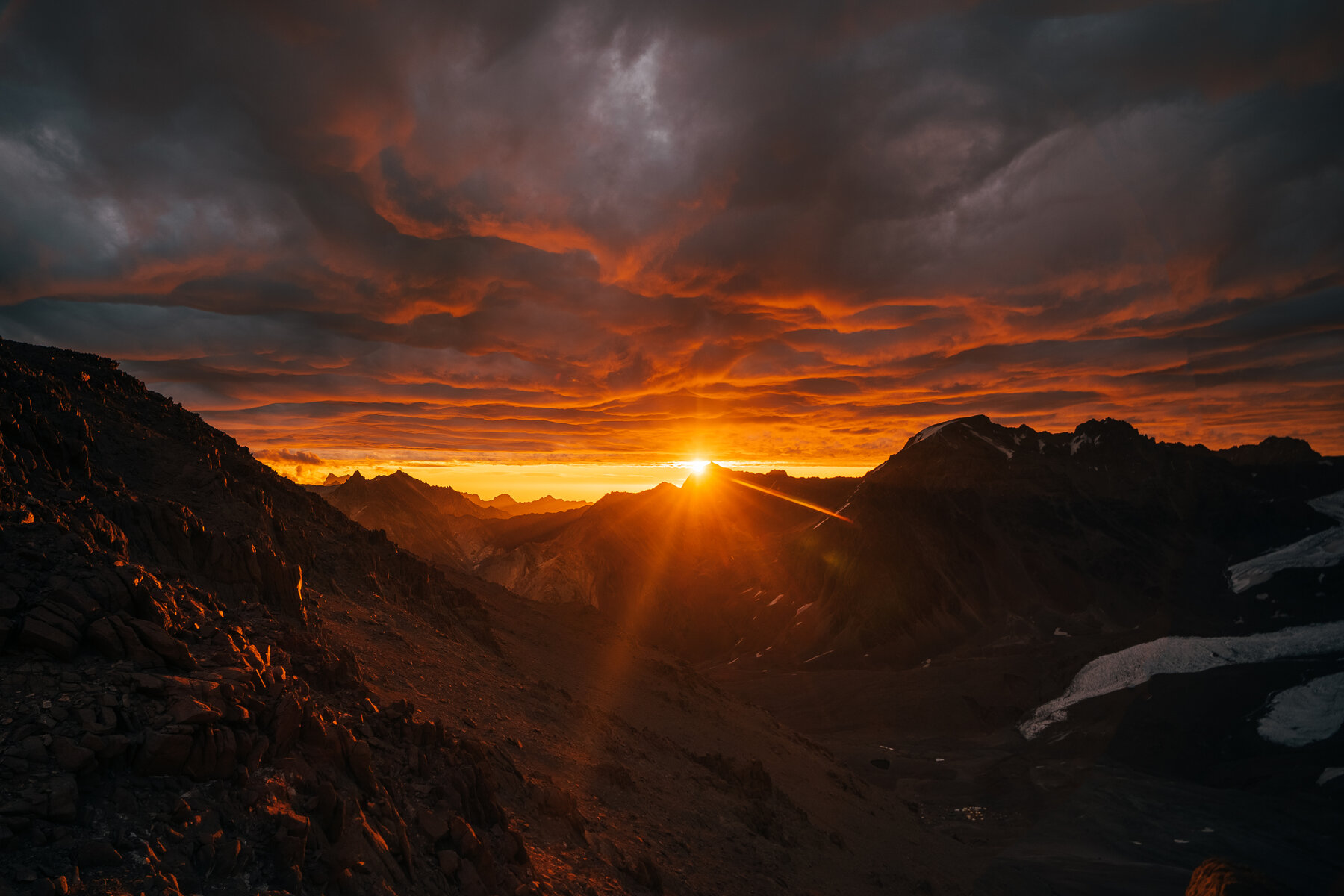
Fiery sunrise over the Andes with dramatic orange and red clouds above mountain silhouettes
First light over the Andes. The sky catches fire before the sun clears the ridgeline.
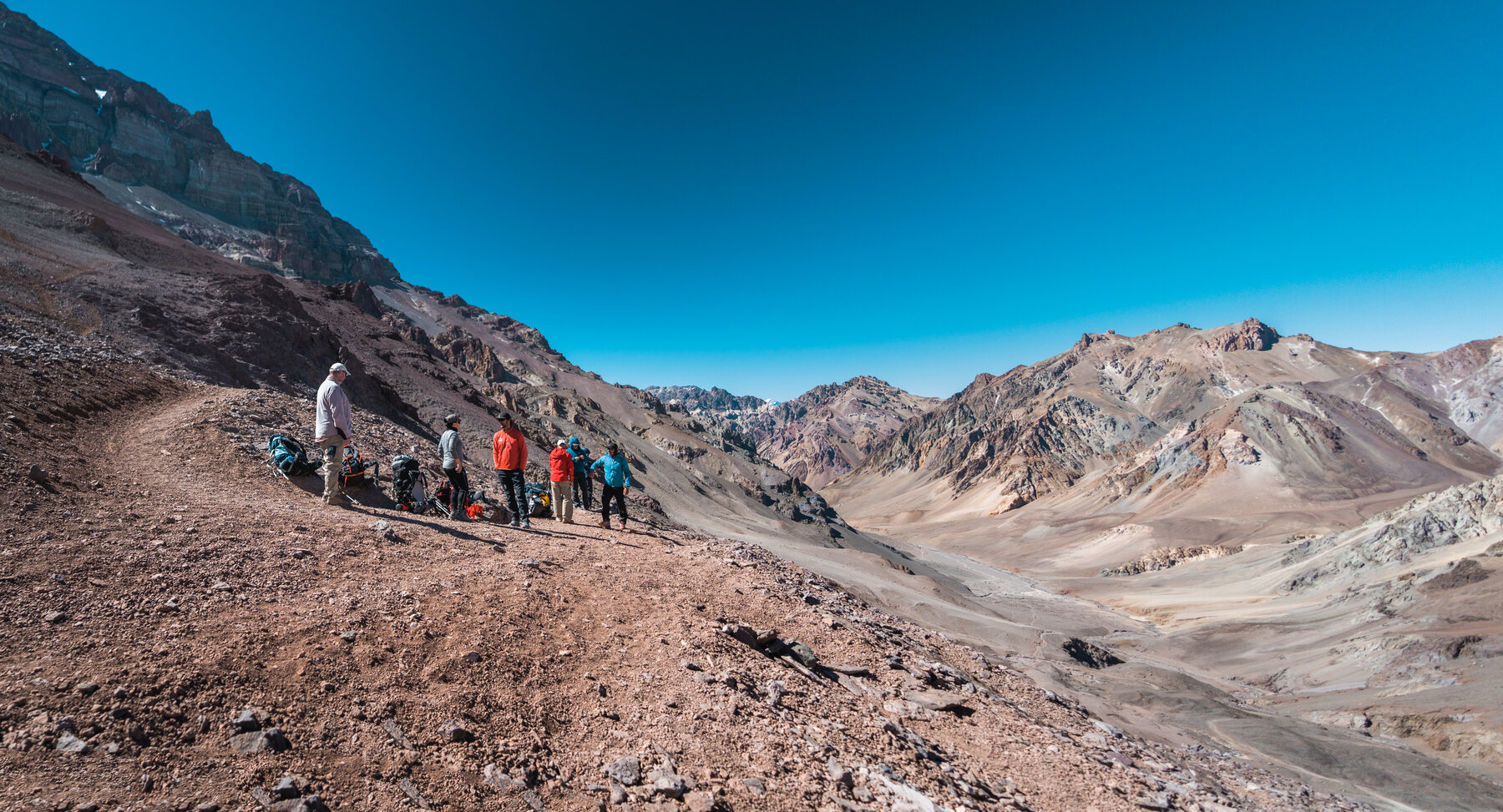
Climbers on a high traverse on Aconcagua with the valley far below
Climbing higher into the Andes, the valley dropping away far below.

Day 13: The Summit

February 13, 2019 · Camp 3 → Summit (6,961 m / 22,838 ft)

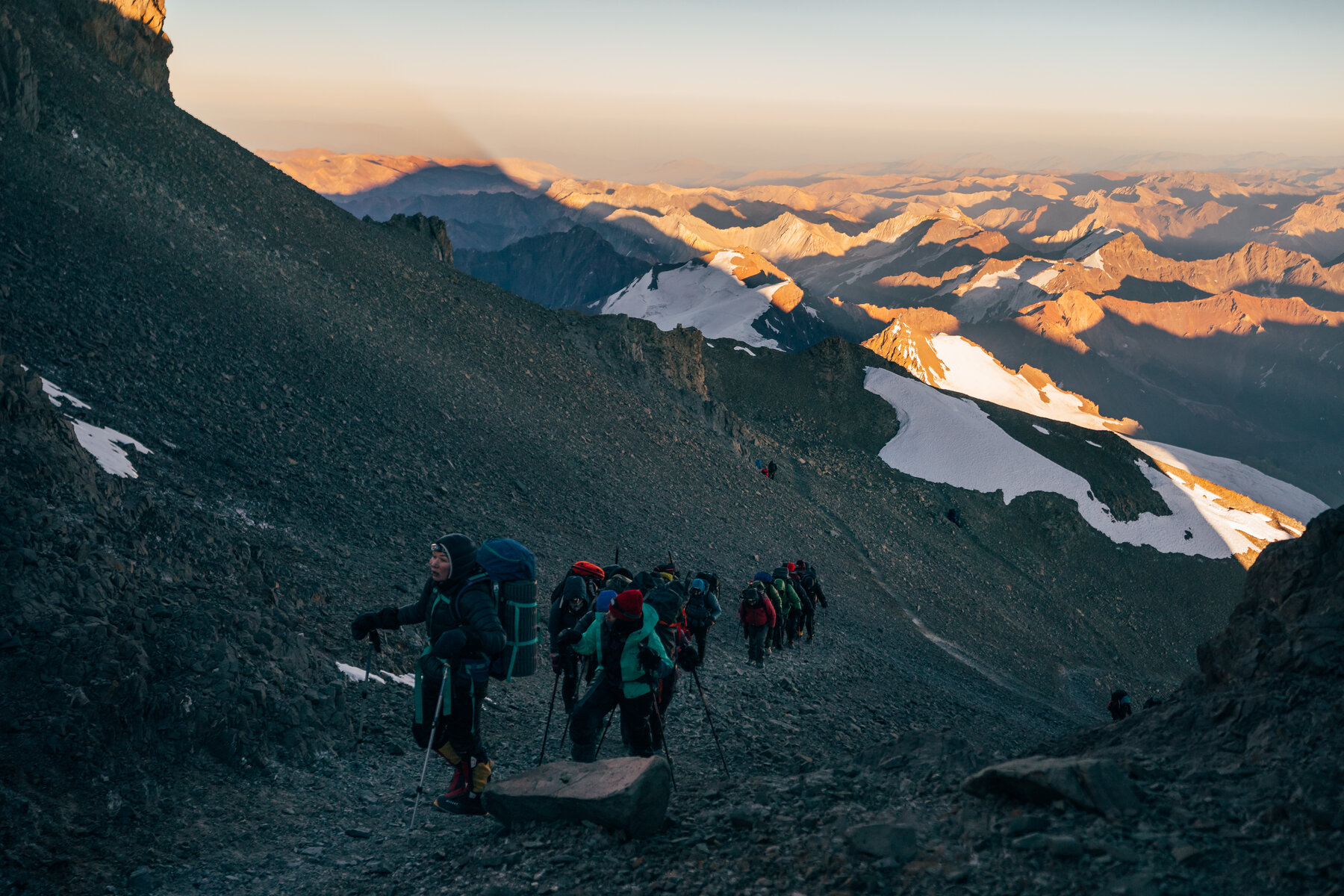
Summit day on Aconcagua starts in total darkness. We left Camp 3 at 4:30 AM, headlamps on, layered in every piece of clothing we had. The air was bone-chillingly cold, easily minus thirty Celsius, and the wind was relentless. From Camp 3 the route climbs steadily to Independencia, then crosses an exposed face where frigid gusts blow snow in your face for a solid hour before the brief shelter of a rock outcrop called the Dedo. What follows is La Canaleta, an eternal-feeling climb up hard snow and ice where the summit never seems to get closer. It's the most mentally draining stretch of the entire climb.

Team on the final approach to Aconcagua summit in golden morning light
The final approach. Golden light breaking over the Andes as we push toward the summit.

As the sun came up, the world transformed. The entire Andes range lit up in gold and orange, peak after peak stretching to the horizon in every direction. We could see into Chile to the west, across the Argentine plains to the east. The scale of it was overwhelming. At this altitude, every step requires four or five breaths. Your legs feel like concrete. But the light, the views, and the knowledge that you're almost there push you forward.

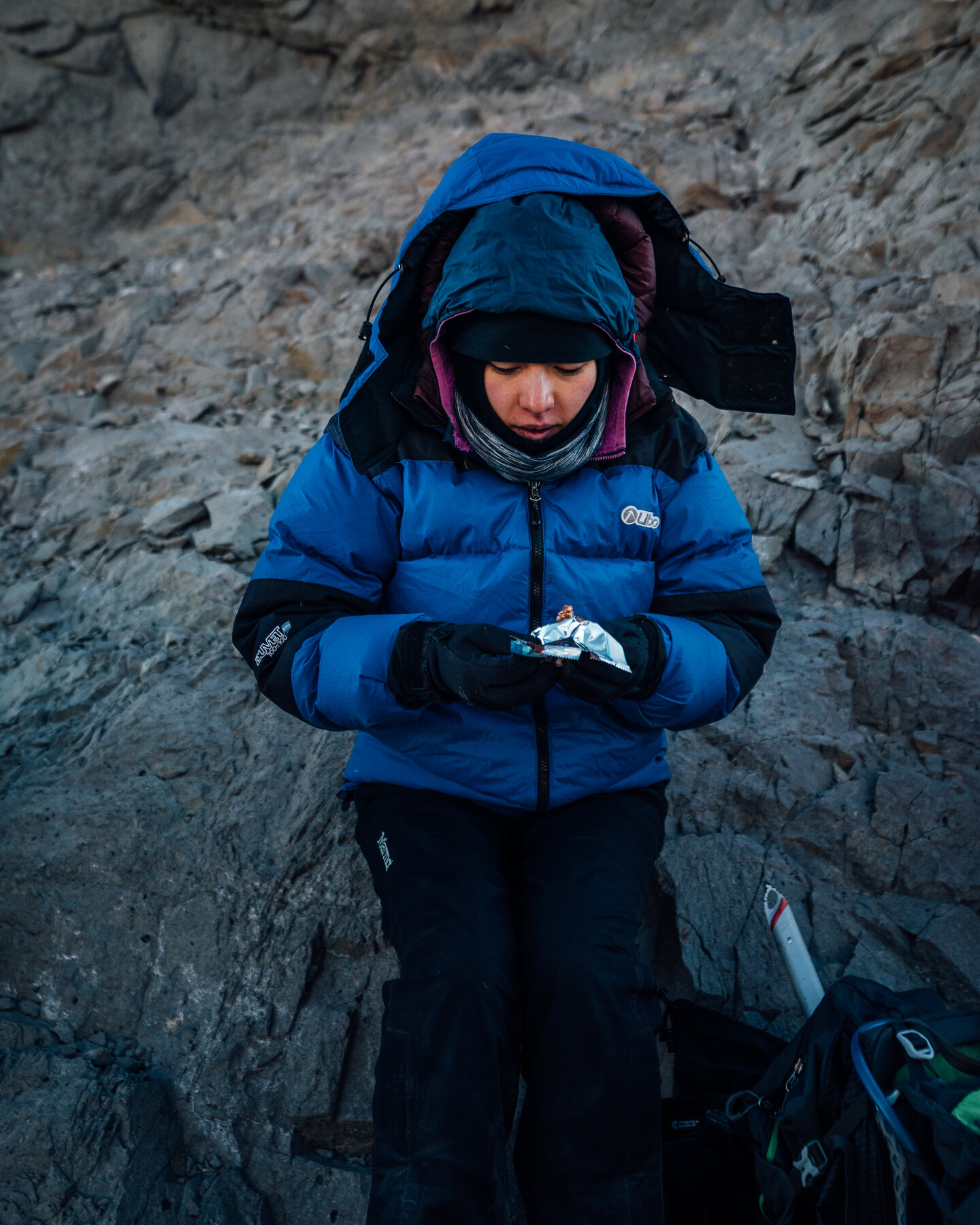
Grace in full summit gear on the final approach to Aconcagua summit
Grace on the final push. Focused, exhausted, and completely locked in.
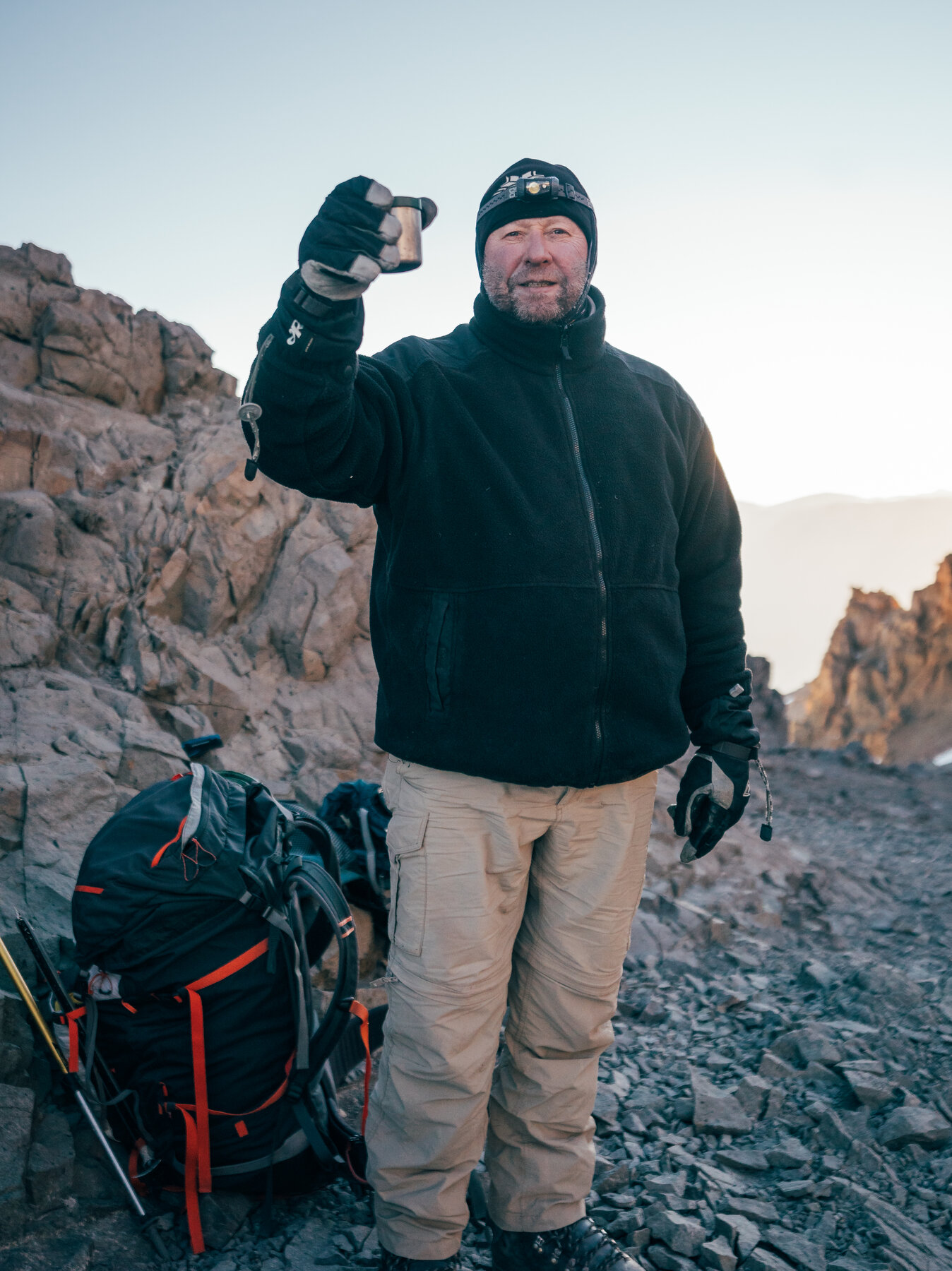
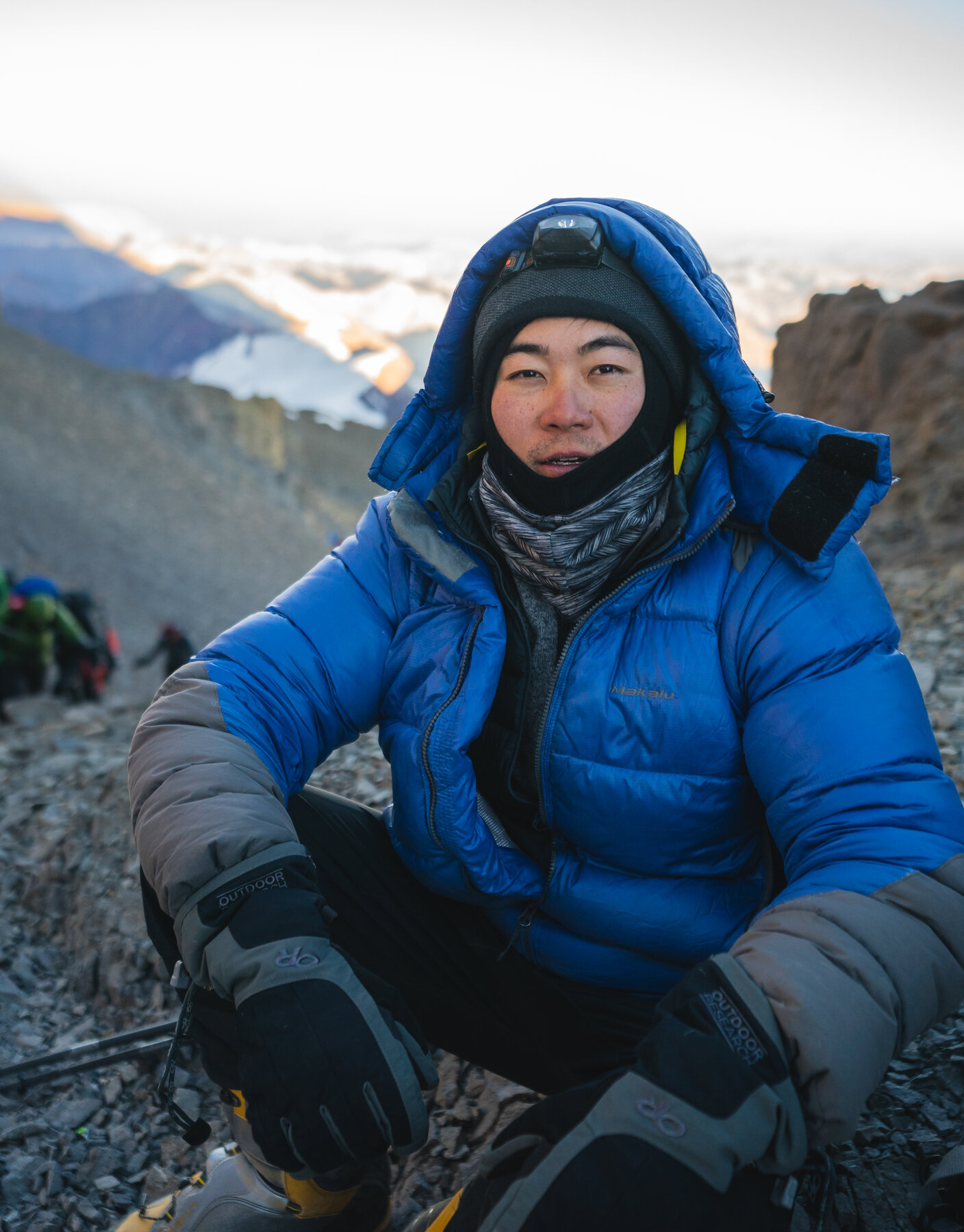
Bearded climber in a black jacket and beanie raising a gloved hand beside his pack on rocky ground high on the mountain
One of our teammates pausing for the camera, pack at his feet, the mountains dropping away behind.

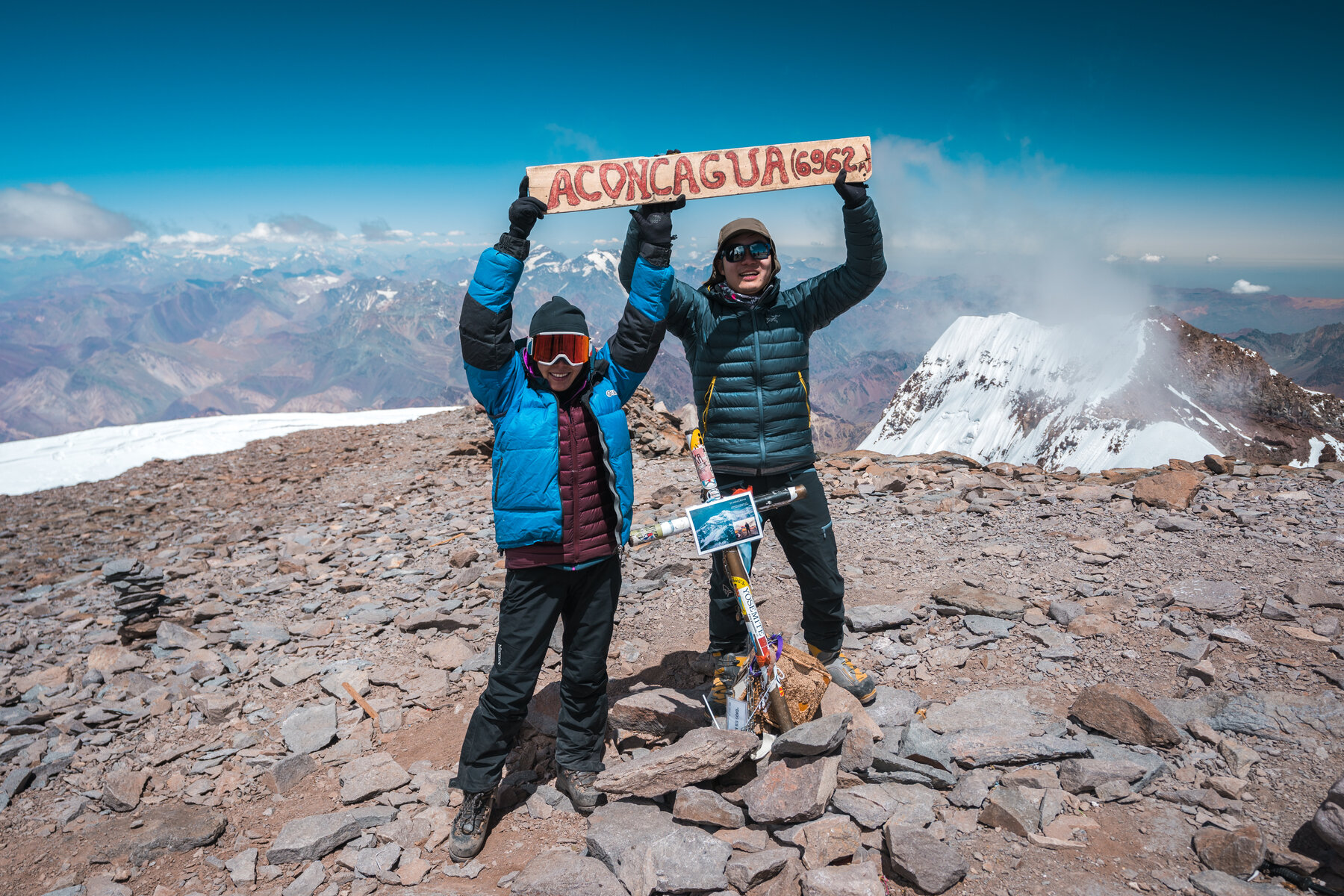
And then we were there. 6,961 meters. The highest point in the Western Hemisphere. The highest point outside of Asia. The wind was howling, the air was thin, and we were standing on top of the Americas. Grace and I held up the summit banner together and felt something that's hard to describe: exhaustion, joy, disbelief, gratitude, all hitting at once.

6,961 m
The Summit · Highest Point in the Western Hemisphere
Jason and Grace holding the Aconcagua 6962 summit banner with arms raised
Jason and Grace at the summit. 6,961 meters. Number two of seven.

We spent about twenty minutes on top, taking photos, catching our breath, and looking out at the most incredible view either of us had ever seen. Peaks in every direction, some in Chile, some in Argentina, all dwarfed by the spot where we stood. Then we started down. The descent is its own challenge, but the hard part was done.

Grace sitting on rocks near the Aconcagua summit in a blue down jacket with mountains behind
Grace taking it all in near the summit. The entire Andes stretched out below.
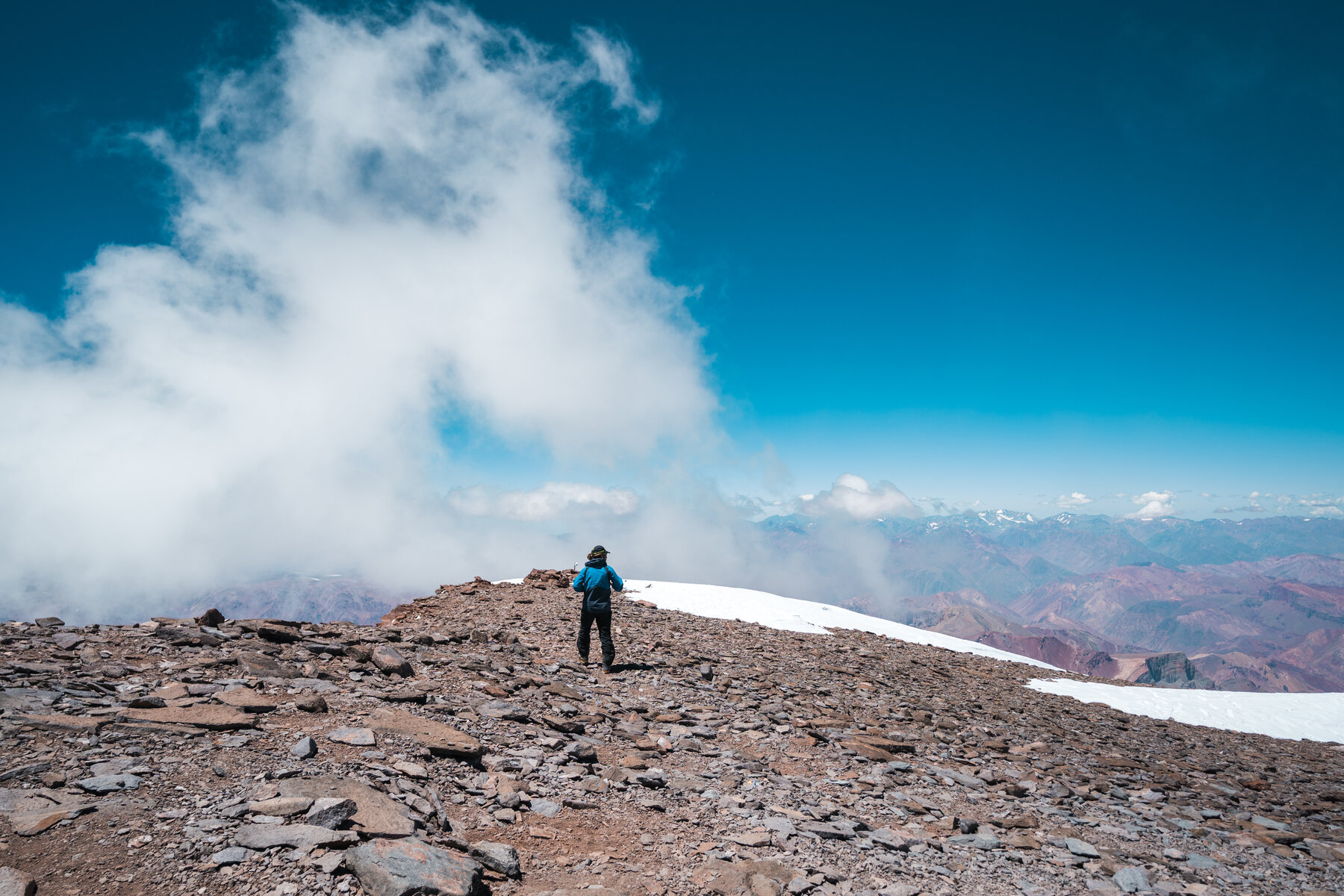
Solo climber standing on Aconcagua summit with vast landscape below
Alone at the top of the Americas. A view that makes every painful step worth it.
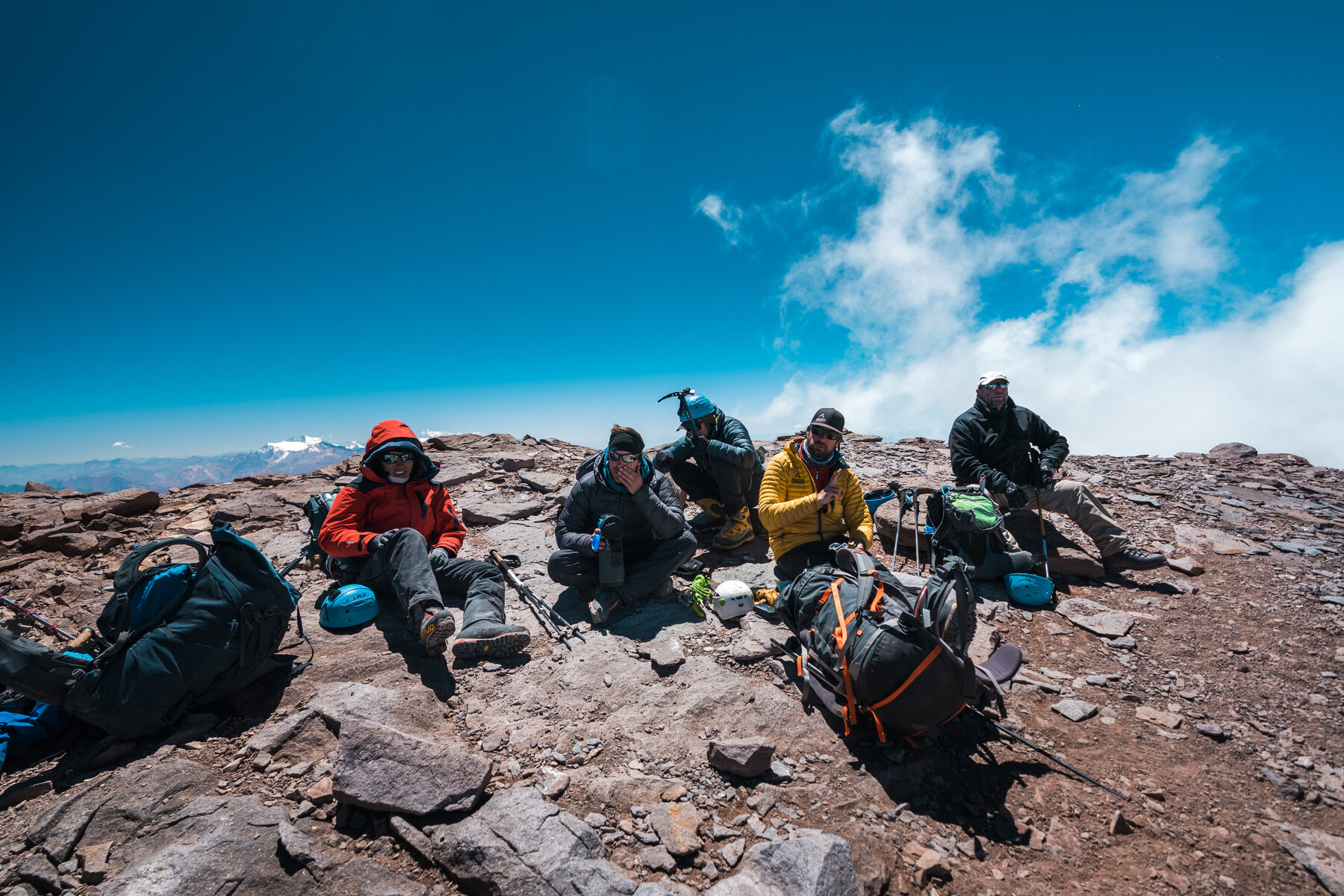
The full climbing team resting together on the summit of Aconcagua
The whole team at the top. Two summits down, five to go.
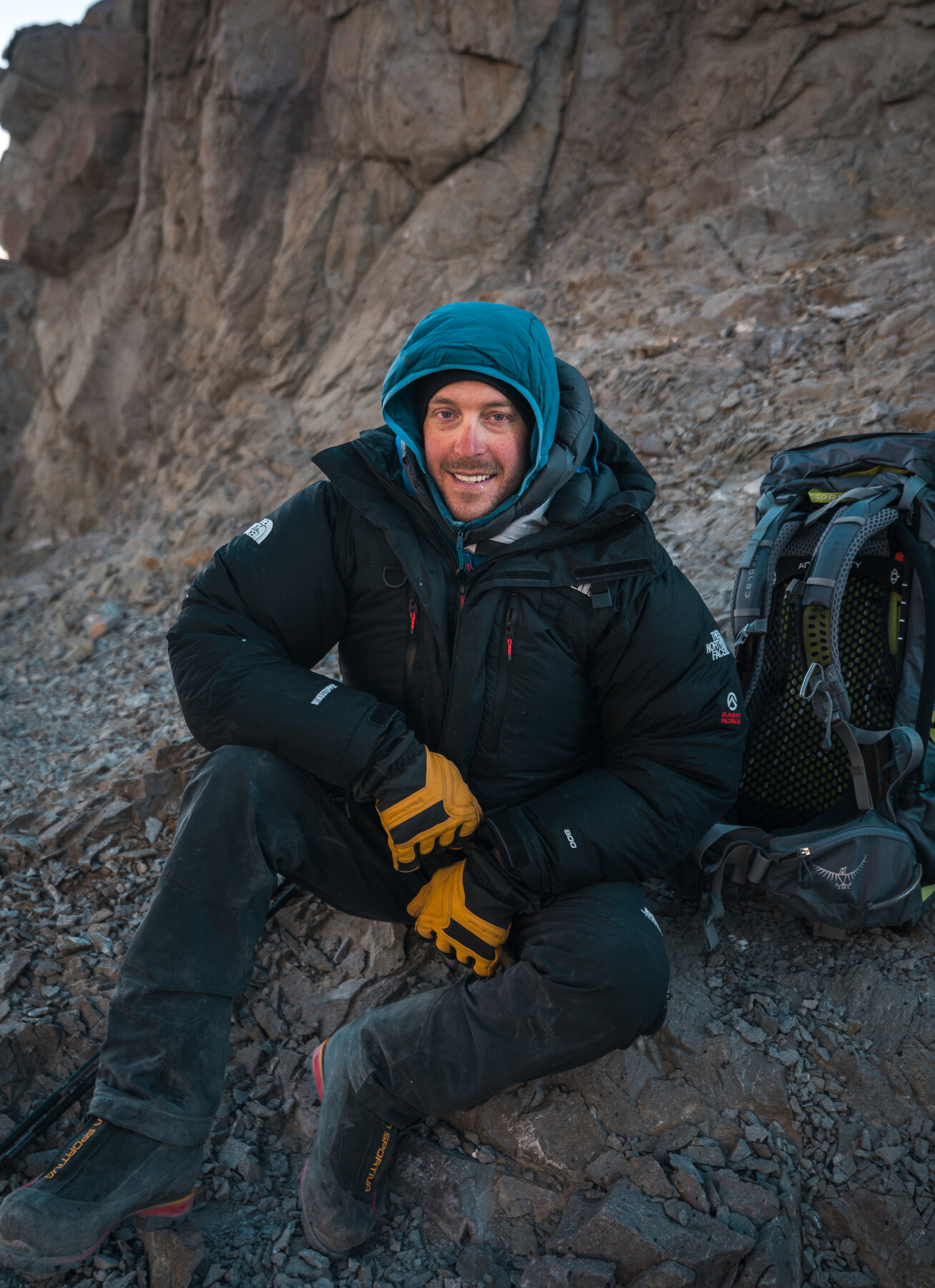
Smiling team member in black North Face jacket and blue hood sitting on rocks near the summit
One of our guides taking a well-earned break near the summit. All smiles after the push.
Panoramic view of the Andes from Aconcagua summit
The Andes panorama from the top. Peak after peak after peak, as far as the eye can see.

Planning Your Aconcagua Climb

TL;DR

Normal Route from the northwest, early February (peak season). Budget 14–20 days including acclimatization. Non-technical but extremely demanding due to altitude and wind. Fly into Mendoza, drive to Horcones Valley trailhead. Summit push starts around 4 AM from Camp 3. Prior high-altitude experience strongly recommended. Permits required through Aconcagua Provincial Park.

When to Go

The climbing season runs from mid-November through mid-March, with January and February offering the best weather windows. We climbed in early February and had a strong summit-day window despite cold and wind throughout the expedition.

Getting There

Fly into Mendoza, Argentina. From there it's about a three-hour drive west to the Horcones Valley trailhead at the edge of Aconcagua Provincial Park. Most guide companies arrange transfers and handle the park permits.

The Route

The Normal Route approaches from the northwest. It's non-technical but extremely demanding due to altitude and exposure. The route goes through Confluencia, Plaza de Mulas base camp, and three higher camps before the summit push. Expect 14 to 20 days total.

Fitness and Skills

No technical climbing is required on the Normal Route, but the altitude demands excellent cardiovascular fitness. Prior high-altitude experience is strongly recommended. The Canaleta section near the summit is physically grueling even for experienced mountaineers.

Altitude and Acclimatization

Aconcagua's nearly 7,000-meter altitude is the defining challenge. Multiple rest and acclimatization days are built into the schedule. Go high, sleep low. Don't rush, don't skip rest days, and listen to your body and your guides.

Guide Company

We climbed with Mountain Professionals, led by Ryan Waters. Their experience, logistics, and steady judgment made an enormous difference. On a peak this big, your guide team is everything.